
Bloomsday, Dublin's Joycean Celebration of Venereal Disease
Bloomsday is almost upon us, that annual festival cherishing the inscrutable works of James Joyce, whose chief celebrants have always counted themselves among the enlightened and most progressive in an Irish society they yearn to reshape in the image of their muse and toothbrush-moustachioed Sibylline oracle.
We can profit further by the comparison, for Joyce's classically-titled opus Ulysses is often no less cryptic and fabulous than anything recorded in Greek hexameter by those ancient Sibyls.
Broken sentences, random snippets of thought, disjointed concepts jostling one another for attention, fragmentary and ad-hoc wording, the Joycean "stream of consciousness" style of writing is pored over and examined in almost every light and from every angle to unearth all possible meanings and interpret according the reader's philosophical and dare I say sociological leanings.
Below we present an example of this much-admired if rarely emulated writing technique from James Joyce's Ulysses, in Molly Bloom’s final words – some of the last words in the book:
"let me see if I can doze off 1 2 3 4 5 what kind of flowers are those they invented like the stars the wallpaper in Lombard street was much nicer the apron he gave me was like that something only I only wore it twice better lower this lamp and try again so as I can get up early Ill go to Lambes there beside Findlaters and get them to send us some flowers to put about the place in case he brings him home tomorrow today I mean no no Fridays an unlucky day first I want to do the place up someway the dust grows in it"
Whether or not one finds this style appealing, let alone worthy of declaring Joyce one of the most influential authors of the twentieth century, a liberator and emancipator, the epitome of Modernism, as many have, none can deny its peculiarity. These are not combinations of words and sentences you're likely to meet as everyday or anyday occurrences.
The less cryptic elements of his writing tend towards the titillating and transgressive, straying at times into the pornographic, explaining a certain amount of his appeal to some audiences, but Joyce wanted Ulysses to be "encyclopedic". He fell somewhat short of the mark but landed squarely in "psychedelic", fulfilling at least his desire that future generations should struggle to understand what on earth he was talking about.
However, modern research has begun to shine a different light on Joyce's life and questions whether this, and indeed almost all of his work, was the product of his peculiar genius or the result of another condition entirely.
Despite being one of the most notorious authors of Irish descent, Joyce had few positive feelings towards his homeland, an attitude which has been enthusiastically adopted and perhaps in large part accounts for his popularity among his contemporary fans.
"Hatred" would probably not be hyperbole when used to describe Joyce's feelings towards his home country, and for better or worse the reasons for his ill-will are not particularly difficult to discern.
As a young man, having received what he felt was a spiritual awakening at the hands of a prostitute near one of Dublin's canals, much of his life was spent in a meandering protest against the Catholic morality of a country which denied the value of such experiences.
Love may love to love love, to paraphrase Joyce, but of course the Irish women forced into prostitution by incompetent if not outright malevolent British administration might phrase the situation differently. Be that as it may, and in all probability as a result, much of his creative output was likely heavily influenced by a lifelong and increasingly serious syphilis infection, according to Harvard scholar and lecturer Kevin Birmingham[1].
This affliction can cause psychiatric disorders including depression, mania, psychosis, personality changes, delirium and dementia, any of which might lend themselves to an explanation for the rambling, disconnected and occasionally scatological "stream of consciousness" style of writing.
Fellow sufferers included such luminaries as Al Capone, whose mental age declined to that of a 7-year-old as a result of contracting neurosyphilis from frequenting prostitutes, and whose lifelong erratic behaviour is now thought to have been strongly linked to his condition.
In "Joyce's Ulysses, The Most Dangerous Book", Birmingham writes that Joyce was going blind due to a severe and poorly treated case of syphilis – "his eye attacks were recurrent because syphilis advances in waves of bacterial growth and dormancy". The array of symptoms Joyce described in detail to his correspondents, "the abscesses that ravaged his mouth and the large 'boil' on his shoulder", were probably syphilitic, writes Birmingham. "Syphilis 'disabled' his right arm in 1907", and the psychological toll of the disease "likely caused Joyce's periodic fainting spells, his insomnia and his 'nervous collapses'", according to the scholar.
While there were many rumours that Joyce was so-afflicted while he was alive – perhaps prompting him to write, in 1931, as his vision faded entirely, "I deserve all this on account of my many iniquities" – it was first openly claimed in 1975. The notion was ridiculed by many of Joyce's admirers, no doubt uncomfortably aware of the implications, until the same happened again in 1995, when Kathleen Ferris's James Joyce and the Burden of Disease repeated that Joyce was riddled with syphilis for most of his adult life.
Birmingham continues, "There are very few ailments that cause decades of recurrent anterior uveitis (the current term for 'iritis'). Syphilis was by far the most common at the time, and yet Ellmann doesn't even mention the possibility that syphilis caused it."
He then proceeded to research the treatments Joyce had been receiving for his illness, and what else these medicines might have been used for. The results were conclusive – Joyce himself referred to injections of arsenic and phosphorous he was receiving, which only fit one prescription: galyl, used to treat syphilis and nothing else. Birmingham believes Joyce chose to use this drug because the main alternative, salvarsan, could further damage his eyesight.
Birmingham writes: "The more challenging part was making sure that galyl was the only injectable medication of arsenic and phosphorus. I had to prove a negative. Early 20th-century medicine isn't my area of expertise, so I contacted a couple of librarians at Harvard's Library of Medicine and the Centre of the History of Medicine, and they helped me search. I went through various pharmacopeias and national formularies (French, British and American) and couldn't find any other example of injectable medication of arsenic and phosphorus."
Joyce's doctor, Louis Borsch, whom he had been seeing regularly for years, was treating him – ineffectively – for syphilis, according to the academic. Borsch "was reputable, and he knew what he was doing," said the scholar. So "the only way Joyce didn't have syphilis is if his examining doctor was somehow wrong. Syphilis is not difficult to diagnose, and you don't give someone three weeks of injections of an anti-syphilitic medication unless you're confident in your diagnosis.
"Add to Joyce's treatment (and his penchant for prostitutes) the fact that syphilis is virtually the only reasonable explanation for Joyce's decades of symptoms, and it seems rather difficult to refute."
Mentions and hints of syphilis can be found throughout Joyce's work. In his story The Sisters, part of Dubliners, he writes of a priest whose sickness, which "affected his mind", is sometimes seen as the final stages of syphilis. In Ulysses, he goes on: "Thrust syphilis down to hell and with him those other licensed spirits", and warns that Dublin's "nighttown" and its "women of ill fame" is "a regular deathtrap for young fellows".
Before penicillin was developed, a strong stigma was attached to syphilis and its overtones of sexual iniquity, which would explain why Joyce never admitted to having the disease.
The implications are wide-ranging, not least for his contemporary fan club, who must now come to terms with the reality that the vision of Ireland they have been trying to shape was originally shaped by an unpleasant sexually transmitted bacterial infection which medicine, at the time, was too primitive to treat.
Sadly, sheer momentum makes the news unlikely to cause much introspection, but at least it adds a new, dare I say, Joycean, dimension to the festivities.
[1] https://www.theguardian.com/books/2014/jun/03/james-joyce-syphilis-study-ulysses-drug-sight
If you'd like to help with producing further articles, please sign up here!
More articles can be found here.
The project will follow in their footsteps along the path laid down by Hyde, O'Conaire, MacNeill, Cusack and many others through sharing news, ideas, articles of Irish cultural interest and more, as well as helping to support Irish language and cultural initiatives. You can find out more about An Claíomh Solais by clicking on the buttons below, or join our team as we begin the great Gaelic restoration!


Ode to John Devoy, a Forgotten Hero
A forgotten hero it has been said
Was born in Kill at a time many tears in this country were shed
Just before the Great Hunger this child did arrive
And lucky for us Irish he was one who would survive
An immense gra for Irish freedom he held in his heart
And it was when he was young that he first made a start
In his quest to release us Irish from beneath British rule
He was beaten for not singing “God Save the Queen” in his school
Involved in three wars he was one of a few
To take part in all conflicts and see
Read more...
An Interview with Patrick Quinlan from the National Party
Welcome to another in our series of interviews with prominent figures and rising stars in contemporary Irish nationalism!
Today we're talking to Patrick Quinlan from the National Party, a rapidly growing and influential political organisation in Ireland, one of the few if not the only such group with actual elected representatives. Read on to learn about engaging with the system, winning hearts and minds, and the political future for Irish nationalism!
Perhaps you could tell us a little bit about yourself to begin with?
I'm Patrick Quin
Read more...
An interview with Rob Carry
Good afternoon! As part of our ongoing series on rising nationalist stars and voices in Ireland, we're delighted to be able to introduce local community activist, businessman and politician, Rob Carry!
We've been talking about his amazing work for and with his community, as well as his aspirations and plans for the future.
ACS: Can you tell us a little about yourself, your background, and where you're coming from?
RC: Sure. So I’m a small business owner (I run a commercial gym, a martial arts club
Read more...
An Interview with Gavin from Offgrid Ireland
Good morning and welcome to another in our series of interviews with prominent figures and rising stars in modern Irish nationalism!
Today we're talking to Gavin from a prominent and influential online discussion group, the X SPACES Éire Community. This very active group has at one time or another hosted many well-known nationalist names and continues to grow in both size and influence.
ACS: Can you share with our readers some of your background and a little about who you are?
OI: I am an Offaly man, born and bred, now in my la
Read more...
A New Voice For Ireland
We are pleased to introduce a new rising star among Irish nationalists - although she needs no introduction for many of you who have attended Irish Ireland protests recently - Ciara Ní Mhainnín! Her uncompromising voice offers a clear challenge to the establishment and a great example for us all to follow.
Ciara very kindly took the time to join us in an online interview, which we are delighted to publish here.
ACS: What made you decide to get involved with the Irish Ireland cause, was there one particular event or was it more of a process?
Read more...
The last address of Thomas MacDonagh
There is not much left to say. The Proclamation of the Irish Republic has been adduced in evidence against me as one of the Signatories. I adhere to every statement in the Proclamation. You think it already a dead and buried letter, but it lives, it lives. From minds alight with Ireland’s vivid intellect it sprang; in hearts aflame with Ireland’s mighty love it was conceived. Such documents do not die.
The British occupation of Ireland has never for more than one hundred years been compelled to confront in the field of fight a Rising so formidable as that which overwhe
Read more...
Recent News
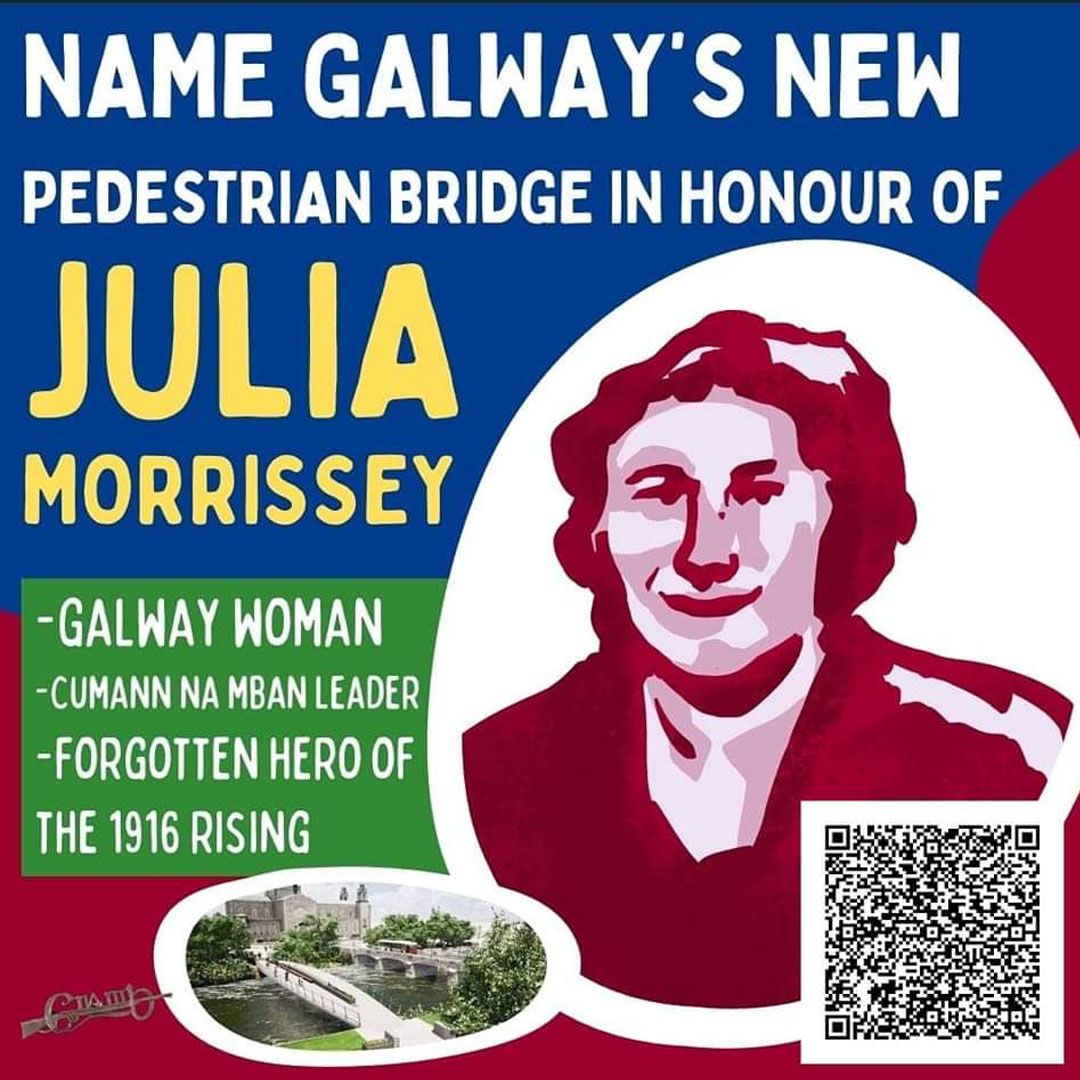
Name Galway's New Pedestrian Bridge in Honour of 1916 Hero Julia Morrissey
An Athenry native, Julia Morrissey, was a key figure in Cumann na mBan's Galway branch. In 1916, she commanded a group of 50 women during Easter week, as part of the rebellion in Galway that was led by Liam Mellows. When Mellows first came to Athenry in 1915, Mor... [more]
Human activity discovered in Ireland 33000 years ago
A REINDEER BONE fragment uncovered in a cave contains a revelation set to dramatically alter the understanding of Irish human history. The bone fragment was found at Castlepook Cave near Doneraile in north Cork where a mammoth bone was discovered in 1972. T... [more]
Wolfe Tones announce anniversary gig
After breaking records at Electric Picnic over the weekend, the Wolfe Tones are set to mark six decades of making music with an anniversary gig in Dublin next year. The Wolfe Tones drew the largest crowd to date to the festival’s Electric Arena on Sunday as a s... [more]
RIA culture night 2023
Come and join us on Culture Night 2023, we will have lots of cultural activities for all ages! Explore the Royal Irish Academy - a hidden Georgian gem tucked away on Dawson Street. View the earliest example of Irish writing - the 6th century Cathach, have a go at som... [more]
More than one million people are actively learning Irish
More than one million people are actively learning Irish on Duolingo according to data from the language app. A recent report (June 2021) listed Irish as the 16th most popular language to learn on the app, with 1.10 million users actively learning the language. ... [more]
United Ireland poll
Linda Ervine places herself in the “don’t know” group when it comes to a united Ireland, saying: “I’m one of those people that will have to be convinced.” Almost one in five voters in Northern Ireland are in the same category, acco... [more]