

Nationalists and Internationalists
The following forms correspondence between Griffith, as editor of Sinn Féin, and Francis Sheehy-Skeffington, a pacifist and Irish nationalist later summarily executed by British forces during the Easter Rising, on a eulogy Griffith wrote for the then-recently deceased Frederick Ryan, an Irish socialist republican where he questioned Ryan’s adherence to nationalism.
I.
Thus Mr. Sheehy-Skeffington writes:—
‘In your appreciative notice of Fred Ryan you say that he was not a Nationalist. This rather surprises me, as, knowing him intimately for seven or eight years, I have always regarded him as one of the best Nationalists I knew. No doubt the difference between us is largely one of definition. But I should be interested to see how you would frame a definition of Nationalism that would exclude Fred Ryan.’
A Nationalist is one who sets the interest of his nation above democracy and aristocracy, and renders to it alone undivided allegiance. Further, a Nationalist is at one with the spirit and tradition of his country.
II.
Thus Mr. Sheehy-Skeffington:—
‘Your attempt to define ‘a Nationalist’ so as to exclude Fred Ryan is a characteristic example of what he used to reprobate as a ‘metaphysical’ way of looking at concrete questions. ‘A Nationalist is one who sets the interest of his nation above democracy and aristocracy.’ But what is ‘his nation,’ apart from the human individuals who make up that nation? And how is it possible, except in mere word-spinning, to separate the interest of these individuals from the solution of the problems involved in the mention of democracy and aristocracy?’
‘Let me illustrate by three quotations from Fred Ryan’s essays:
‘I claim also to be a lover of Ireland. Though by ‘Ireland’ I do not mean any ‘literary,’ or mystic entity or any ‘nationality’ divorced from the real life of the people. By Ireland I mean the peasants in the fields, the workers in the factories, the teachers in the schools, the professors in the colleges, and all others who labour in Ireland and desire to make this people a great people, an intellectual people, a noble people.
But in building up that people we must, I submit, keep our eyes fixed on the permanent standards of right and wrong, of good politics and bad, and less and less on the mere ebb and flow of national impulse. Our desire should be not to copy England or any other nation, still less to aimlessly differentiate ourselves from other nations, but to choose the best from all nations. It is an ignoble thing to be a sycophant; it is a foolish thing to be a factious antagonist.
If we possess a good method or a useful custom it is unwise to abandon it merely because another nation which we dislike has it too. When the hurricanes of national and racial antagonism die away we must always come back to equity, to utility, and to righteousness.’
‘And again, with reference, to some such definition as yours:—
‘Much more profitable than such theorising is the problem of how to create in Ireland a people, healthy, educated, cultured in the best sense, with sufficient material comfort, developing their minds and their bodies to the end of maximising life, sensitive to intellectual and moral values, and conducting their national life on lines of justice, and freedom, and good faith… I stand for Irish independence because by it alone can we obtain the machinery to produce this. No alien administration can possibly produce it.’
‘And yet again:—
‘We desire to concentrate on real issues, on real development, development of life, and all that makes life nobler and more humane. But working for that ideal we are Nationalists perforce, because no moral or political progress is possible under political servitude… Those who desire to better the moral, intellectual, and social condition of the Irish people must work for National freedom—not for the sake of a new flag, not for the sake of a poetic phrase, not as a quasi-religious exercise or a literary pose, not for the purpose of ministering to a petty collective vanity or racial pride, but for a clear, definite, and real reason: Only by National freedom shall we attain the machinery for social reform.’
‘Fred Ryan was an advocate of the complete political independence of the Irish people, he desired to see them absolutely free to work out their own destinies without foreign intervention. Why should you seek to deny him the title of Nationalist because his vision of what might and should be done in and by a free Ireland was different from yours?’
We did not deny Mr. Ryan the title of Nationalist because his vision of what a free Ireland ought to do was different from ours, but because he himself implied, like Mr. Skeffington in his present letter, that a nation was nothing more than a collection of human beings, and that the interests of the nation were nothing more than the interests of the said human beings—a body without a soul.
Ten castaways on a coral island would have been as much a nation to Mr. Ryan as the Ireland that stretches back to Emain Macha. No doubt Mr. Ryan loved Ireland as a geometrician might love an equilateral triangle, but he loved half-a-dozen other countries in equal fashion. Egypt, Persia, China were as much to him as his own country, and those who held that the business of a man is with his own nation and that no man has a right to give her services to another nation howsoever in need of them while his own is in straits were Obscurantists.
When we say we love Ireland we do not mean by Ireland the peasants in the fields, the workers in the factories, the teachers in the schools, the professors in the colleges—we mean the soul into which we were born and which was born into us. If this be a metaphysical way of looking at concrete questions we shall remain in the metaphysical pit along with the unenlightened world that existed before Rousseau and the Manchester school whom poor Ryan so implicitly accepted as the repository of the wisdom of all the ages.
As to Mr. Skeffington’s questions, ‘his nation’ is a man’s ancestral title on the earth, which it is his first duty and point of honour to maintain, and as to the ‘solution of problems involved in democracy and aristocracy,’ the business of the nation is not to let any ‘problem’ or its ‘solution,’ interfere with its continued existence as a distinctive and conserving force. The man who declared he wanted National freedom in order to promote social reform did not understand the meaning of the nation.
Arthur Griffith, from Sinn Féin
Article originally published on: Saturday 26th April 1913If you'd like to help with producing further articles, please sign up here!
More articles can be found here.
The project will follow in their footsteps along the path laid down by Hyde, O'Conaire, MacNeill, Cusack and many others through sharing news, ideas, articles of Irish cultural interest and more, as well as helping to support Irish language and cultural initiatives. You can find out more about An Claíomh Solais by clicking on the buttons below, or join our team as we begin the great Gaelic restoration!
You don't get to betray us and smile
You don’t get to lecture us on our blood and our past,
Famine headstones paving a road any can pass.
Our villages hollow, our young forced to flee,
While newcomers are housed and our people come last —
that’s your “compassionate” decree.
We remember the coffin ships, the millions who died,
Under cold British rules and indifferent pride.
That horror was on us by foreign command —
Not a blank cheque for every stranger to claim our land.
We emigrated through hardship, built lives far a
Read more...
Ode to John Devoy, a Forgotten Hero
A forgotten hero it has been said
Was born in Kill at a time many tears in this country were shed
Just before the Great Hunger this child did arrive
And lucky for us Irish he was one who would survive
An immense gra for Irish freedom he held in his heart
And it was when he was young that he first made a start
In his quest to release us Irish from beneath British rule
He was beaten for not singing “God Save the Queen” in his school
Involved in three wars he was one of a few
To take part in all conflicts and see
Read more...
An Interview with Patrick Quinlan from the National Party
Welcome to another in our series of interviews with prominent figures and rising stars in contemporary Irish nationalism!
Today we're talking to Patrick Quinlan from the National Party, a rapidly growing and influential political organisation in Ireland, one of the few if not the only such group with actual elected representatives. Read on to learn about engaging with the system, winning hearts and minds, and the political future for Irish nationalism!
Perhaps you could tell us a little bit about yourself to begin with?
I'm Patrick Quin
Read more...
An interview with Rob Carry
Good afternoon! As part of our ongoing series on rising nationalist stars and voices in Ireland, we're delighted to be able to introduce local community activist, businessman and politician, Rob Carry!
We've been talking about his amazing work for and with his community, as well as his aspirations and plans for the future.
ACS: Can you tell us a little about yourself, your background, and where you're coming from?
RC: Sure. So I’m a small business owner (I run a commercial gym, a martial arts club
Read more...
An Interview with Gavin from Offgrid Ireland
Good morning and welcome to another in our series of interviews with prominent figures and rising stars in modern Irish nationalism!
Today we're talking to Gavin from a prominent and influential online discussion group, the X SPACES Éire Community. This very active group has at one time or another hosted many well-known nationalist names and continues to grow in both size and influence.
ACS: Can you share with our readers some of your background and a little about who you are?
OI: I am an Offaly man, born and bred, now in my la
Read more...
A New Voice For Ireland
We are pleased to introduce a new rising star among Irish nationalists - although she needs no introduction for many of you who have attended Irish Ireland protests recently - Ciara Ní Mhainnín! Her uncompromising voice offers a clear challenge to the establishment and a great example for us all to follow.
Ciara very kindly took the time to join us in an online interview, which we are delighted to publish here.
ACS: What made you decide to get involved with the Irish Ireland cause, was there one particular event or was it more of a process?
Read more...
Recent News
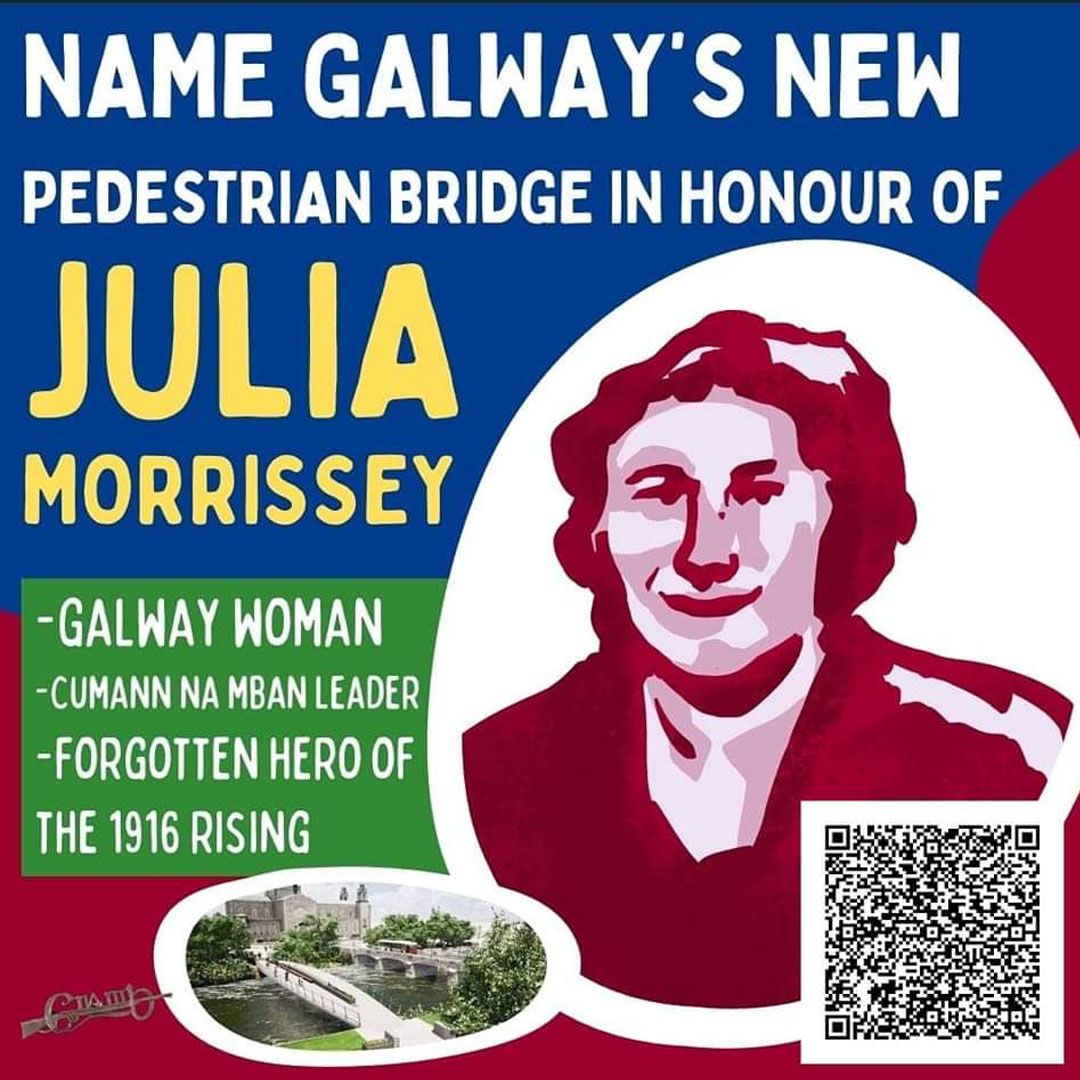
Name Galway's New Pedestrian Bridge in Honour of 1916 Hero Julia Morrissey
An Athenry native, Julia Morrissey, was a key figure in Cumann na mBan's Galway branch. In 1916, she commanded a group of 50 women during Easter week, as part of the rebellion in Galway that was led by Liam Mellows. When Mellows first came to Athenry in 1915, Mor... [more]
Human activity discovered in Ireland 33000 years ago
A REINDEER BONE fragment uncovered in a cave contains a revelation set to dramatically alter the understanding of Irish human history. The bone fragment was found at Castlepook Cave near Doneraile in north Cork where a mammoth bone was discovered in 1972. T... [more]
Wolfe Tones announce anniversary gig
After breaking records at Electric Picnic over the weekend, the Wolfe Tones are set to mark six decades of making music with an anniversary gig in Dublin next year. The Wolfe Tones drew the largest crowd to date to the festival’s Electric Arena on Sunday as a s... [more]
RIA culture night 2023
Come and join us on Culture Night 2023, we will have lots of cultural activities for all ages! Explore the Royal Irish Academy - a hidden Georgian gem tucked away on Dawson Street. View the earliest example of Irish writing - the 6th century Cathach, have a go at som... [more]
More than one million people are actively learning Irish
More than one million people are actively learning Irish on Duolingo according to data from the language app. A recent report (June 2021) listed Irish as the 16th most popular language to learn on the app, with 1.10 million users actively learning the language. ... [more]
United Ireland poll
Linda Ervine places herself in the “don’t know” group when it comes to a united Ireland, saying: “I’m one of those people that will have to be convinced.” Almost one in five voters in Northern Ireland are in the same category, acco... [more]