


Oration at Casement Fort
Men and Women of Kerry, it is a great honour to me to be asked to speak here today – to speak to the great gathering of the men and women of Kerry, of my native county, who have come to this fort in order to show by their presence, and to show to the world that is watching us, that we stand by the same principles that Sir Roger Casement stood by when he mounted that strand.
There are other more fitted to speak to you on this great subject than I am. There are men standing on this fort today who co-operated with Casement – men, against whom one of the charges preferred was their knowledge and their friendship and their co-operation and assistance to Casement. I do not know why it was I was selected to speak here.
Other men were sentenced to death. Men who have worked the County Kerry up to its present attitude should speak here and not I; but being invited, and not being any way “Duholough”, I will try to do my little best to put before you some of the ideals and some of the principles that Roger Casement stood for; and I will also try and tell you some of the work he did for Ireland, both in this country and countries beyond the sea.
Since my very childhood on the side of the hill or the shores of Dingle Bay I heard old native speakers of Corcaguiney tell us of the prophecy of St Columcille. The prophecy stated an O’Donnell would land on the strand at Corcaguiney; that he would land on the sands of his native land, and that he would bring liberty to the shores of Ireland, which we are sighing after for centuries. Old people in Corcaguiney looked forward to this mystical O’Donnell to land on the Strand of Corcaguiney with a powerful army and powerful armaments.
Back in the years of history many an eye similar to the eyes of the old Irish speakers in numerous other countries outside of Ireland, looked on many occasions for the mystical liberator of their country to come with the sword and the bayonet for their deliverance; and it’s no wonder that the people of Kerry thought that the deliverer would come with an army and armaments, and he did come. The mystical man of Columcille’s prophecy came; he cam unknown, but I tell you he is not unknown today.
He is not unknown today, nor will he be unknown tomorrow. He did not bring with him that great army; he brought no great powers in his train to back up his work for Irish liberty; BUT HE BROUGHT WITH HIM A LOVING HEART AND AN UNDAUNTED SPIRIT THAT WILL LIVE IN IRELAND AS LONG AS ANY MAN WILL LIVE WHO BELIEVES IN THE IRISH IDEALS OF AN IRISH REPUBLIC.
In looking back at the history of Ireland we can see clearly before our views many a landmark, many a stepping stone that leads us in our ideals and in our desires, and that screws up our courage in order that we might try to attain for Ireland what the men in the past failed to attain for our country; we look away in the distant ages of the past to the figure of the King who died in the Battle of Clontarf, and we think of the Ireland over which he ruled; and the Ireland of our ideals is a similar one.
We go down the paths of history from the days of the great Brian, and we meet with the O’Neills of Ulster; we meet the chieftains of Munster; we go through the period of Shane O’Neill and down to the days of the sacrifices of Wolfe Tone and Robert Emmet. All the stepping stones of our history are stepping stones of sacrifice – if I may use such words – and in our own age of sacrifice of life for Irish Nationality it is not completed. We had an honour from God – it was a Godly honour, and could not be called by any other name.
We have got the honour from God to live in the years that are at present, and to see men lay down their lives in the spirit of our forefathers laid down theirs. It is an honour only a few generations, and only choice generations of the people of Ireland, have got; and we should thank God that we have lived in the years of Irish Nationality, so militant and so self-sacrificing, and the last stepping stone to Irish liberty was laid down last year – the martyrs of Easter Week and the martyrdom of the beautiful and honourable Casement.
Previous landmarks of our history are dimmed through the passing of many long years; but, the one that is close by, the one that you and I know of, that will be the last stepping stone to the complete and absolute independence of our country. Men would ask some years ago who was Roger Casement?
Roger Casement was born on 1st September in the year 1864. In his early manhood he went into the service of England, where many a good Irishman, through economic reasons, has often to go. For twenty one years of his life he served England, and, during these twenty one years of his life, he felt himself as much in bondage and in chains as he did during his stay in Pentonville Prison last year. I will be able to read for you an extract from one of his letters – one of his letters written in 1914 to a friend of his.
He speaks of his work for England in one of the Republics of South America as a consul General. He said, regarding his work in those far away districts in the southern world – “ALL THAT I EVER DID THAT WAS UNSELFISH AND CHIVALROUS IN PUBLIC LIFE, AND I HAVE STRIVEN TO DO BOTH IN ALL MY PUBLIC SERVICE, HAS BEEN DONE WITH THE IMAGE OF IRELAND BEFORE ME”.
There was Casement wandering over the prairies of South America, wandering over the free Republics of the southern world, with a vision of Ireland, bound in chains, always before his gaze. Imagine how he felt as he went amongst free people, and lived his life in countries while his brain rang with the thought of her bound in chains, with no hopes – no visible hopes – of ever breaking through, no wonder that his solicitude and exile in those countries, swept away his strength and wore away his health, and forced him into retirement in the prime of life.
We can understand the noble and chivalrous heart of Casement bursting with desire to come back to his native land – for there was now a young Ireland that has been reborn in the previous dozen years – to come back and throw his weight in with men who were working and striving to place Irish Nationality on a strong foundation.
“All”, he says, “I have striven for during all my public life has been done with the image of Ireland before me. I looked to Ireland for my ideals when I went to find Leopold on the Congo, and the rubber contractors, and PLEASE GOD, HE SAYS “BEFORE I DIE WE WILL DO SOMETHING FOR IRELAND” – and we have it from God’s own Son that no man can do a greater thing for his friends than lay down his life. And you will see that God has honoured Casement when he called on him to shed his blood for Ireland; to shed his blood in charity and love for the liberty of his people.
During my stay in America in 1914, I had the honour of meeting Casement on a few occasions. At the time he was weak and he was frail in health, but his weakness did not prevent him from touring the States in order to raise funds to arm the Volunteers of Ireland. I was present at the Convention of the ancient Order of Hibernians of Norfolk City, Virginia, when Casement spoke before 4,000 delegates from all parts of the States. He appealed at this time for funds, to arm and equip the Volunteers in Ireland, and a resolution was passed by the delegates in answer to his appeal, pledging themselves to raise in America 400,000 dollars for the purpose of arming and equipping the Volunteers.
The Irish in America clearly saw that Casement’s and the Volunteers’ Leaders only hope of saving the soul of Ireland – to save Ireland from sinking into slavery, and to save the young men of Ireland from being murdered on the plains of Flanders, in order that England might live – they saw that the only guarantee to save the honour of Ireland before the nations of the world was to arm the young men of Ireland.
And the answer to his appeal at the time, showed that the Irish in America, understanding what freedom means, and understanding the only means of acquiring and protecting liberty and freedom, shoveled out their dollars to Casement in order that Ireland might be preserved from tyranny of the Jews and money lenders of London who are at present running the world war.
After his visit to America, Casement, as you know, departed for Germany, that he might get the assistance of the Central Powers to help Ireland to gain the liberty that we have been yearning over for years. We know a good deal about the work of Casement in Germany.
We know one fact that will stand for ever; one fact that Casement is more responsible for than any other Irishman, and that is, the Central Powers, publicly, are pledged to see, that, before peace is declared, and the peace conference is settled, in the new world that will exist after the present was, that Ireland will be one of the free nations of Europe. Ireland’s enemies were Casement’s enemies, and we know how he was brought up before a bench of London Judges.
England believed, and I believe she had a good right for that belief, that a judge and jury could not be found in Ireland to convict Casement of High Treason to his own country. Therefore, they took him to England to convict him of High Treason to England. And they found him guilty, and I think we, today, should ring out our voices and let them be heard from one corner of Ireland to the other, we should shout to the judges of London that Casement was guilty of high treason to England.
There are many things I would like to say to you, but I will read for you a few remarks on Casement’s death that were written in one of the leading newspapers in America. I will show you clearly what these American people thought of the sacrifice of Casement’s life for Ireland. The remarks appeared in a leading paragraph, and they recorded that the English government’s dealing with the Irish people for 300 years had been one long story of tyranny and incredible stupidity; and we believe that the sober judgement of history will rank the hanging of Roger Casement amongst the chief governmental crimes and blunders.
That is what the Irish Americans thought of the sacrifice of Casement’s life for Ireland. But the ministry, when it had Roger Casement in its grip, resolved to put him to death, and the hangman performed his loathsome function; and listen to what the American Journal says – “and that day the brutal empire lost Ireland for ever.” This article finishes up and says: –
“That a country that can provide patriots to die gladly and cheerfully for the cause of liberty and the common good proves to mankind its right to freedom and the government of its own country by its own people.”
The voice of each succeeding patriot and martyr ringing from the scaffold is but another call – a trumpet call to the generations that are to come. The attempt which is meant to strike terror into the hearts of patriots reveals only a fierce resolve to be ever more determined to resist all that tyranny can do to crush the spirit of liberty.
Roger Casement, it says, is not dead. Sir Roger Casement still lives. The English gaolers can bury his body – but his soul lives. He has escaped, and is now where no one can reach him. He lives in Irish hearts a hero. No Scotland Yard men can lay hands on him there. His sacrifice reiterated and renewed the old desire for freedom, and the old spirit of nationality that was left latent in the minds of the Irish Race. I will finish by telling you that, coupled with the sacrifice of the men who were murdered in Kilmainham Gaol.
A few minutes ago when Captain Lynch recited the rosary here before us, I was glad that our meeting took place on Sunday that you might merge your prayers in his. He read out five glorious Mysteries of the rosary; the Mystery of the Resurrection and the Ascension, and it was meet and fitting that these should be the Mysteries of the rosary that we prayed before Heaven today, because you will agree, and everyone will agree, that the resurrection has taken place in the life of Ireland; and let us pray that the resurrection that has taken place in Ireland will never die, will never cease to live until liberty and freedom we have fought and striven for will be ours.
Some men here, I am sure, know more about “Fionn McCumhail” than I do. On one occasion the enemies of “Fionn McCumhail” held him in slavery, and there was but one way in cutting the chains, and that was by sprinkling them in blood. I believe that the sprinkling of the blood of the martyrs of Easter Week is wearing away the chains that have bound Ireland. Our opponents tell us we are criminal idealists. You can see that the men of Easter Week were the most practical Nationalists that ever lived in Ireland for the last 100 years.
There was no dreaming about them or idealism but the dreams and ideals of absolute Irish liberty, and they worked for it and placed it on a foundation that it will never again be taken down from. I had the pleasure during Easter Week – in fact I think it was Wednesday of Easter Week – of receiving a dispatch from Jim Connolly, who commanded in Dublin. His dispatch said, amongst other things: – “The Republican flag still flies triumphantly over Dublin City. There will be glorious days for Ireland yet”. Will you mark these words, my friends? Will you mark the words of Connolly; take them to your heart and think of the mind of the man who saw clearly behind the barricades of Dublin streets, that there would be glorious days for Ireland yet.
Pearse and McDermott told me that the Republican Flag flies triumphantly over Dublin, and that they never withdrew those words. The Republican Flag still today flies over Dublin City, and still flies over every county in Ireland, and any forces of Great Britain, and any army of England, will not drive the tri-colour flag from the hills and fields of Ireland. It is there, and not only can we see it with our eyes, but we can feel it with our minds, because I have seen since I was liberated that there is a tri-colour in the mind of every young man and every young woman from North to South, and from East to West, and though they may tear them down from the house tops, they can never obliterate the tri-colour nor the blood of Easter Week from the minds of the young men of Ireland.
The last words, practically, the last words to his comrades, were told to half a dozen of our boys in Kilmainham by P.H. Pearse on the night before his execution. He told them in Kilmainham Gaol “that the insurrection was a success. We have gained what we were out for. The Irish question is no longer a British imperial question. It is now an International one. Ireland, since Easter Week, has made the Irish question an International one, and you are to keep it an International one here today, and do the same tomorrow, so that no measure of liberty for Ireland will be accepted by the Irish people unless it is guaranteed by the nations of Europe.
Don’t take the pledge of any one nation as guarantee of your liberty. The nations of Europe will guarantee whatever liberty will be accepted by the people of Ireland. If you do that you will be following the path laid down for you by Casement in his work in the United States of America, and in his work in Germany and Austria, and if you accept any half measure you will be working absolutely in opposition to the law and rules laid down by Casement and laid down by Pearse for the people of Ireland.
Those martyrs, who laid down their lives for Ireland, as the American newspapers stated, are not dead. They are living with us today more than they ever did before. It is only fitting that we should honour their memories, and their is only one way of honouring their memories, and that is to help to forward the policy and principles that these men died for in 1916. They knew it was an honour to lay down their lives for Ireland, and many of their friends knew likewise.
I cannot finish my advice to you today without telling you of the words of a mother of one of the boys who dies at Ashbourne, on Easter Week of last year. In our side there were two men killed; one patriot from Lusk, a fine manly fellow, who ran from his work to take up his rifle when we sent out the call. His body was taken to Ashbourne, and the women of Meath, who had heard the rifles ringing the whole long day, were in the house with the body of young Rafferty.
They stepped aside when his mother entered, trembling in fear and sorrow for the young fellow who lost his life, and for the mother, an old woman. She entered and looked at the dead body of her son, and moved the long locks and, looking up towards Heaven, she said – “Thank God it is for Ireland you dies”. Now, say rosaries for Casement, for the dead men of Easter Week, echo out the prayer of this woman of Lusk; cry out to Heaven:- “Thank God it is for Ireland they died”.
The oration delivered by Commandant Thomas Ashe at Casement Fort, Ardfert, Co. Kerry
Article originally published on: Sunday 5th August 1917If you'd like to help with producing further articles, please sign up here!
More articles can be found here.
The project will follow in their footsteps along the path laid down by Hyde, O'Conaire, MacNeill, Cusack and many others through sharing news, ideas, articles of Irish cultural interest and more, as well as helping to support Irish language and cultural initiatives. You can find out more about An Claíomh Solais by clicking on the buttons below, or join our team as we begin the great Gaelic restoration!
Ode to John Devoy, a Forgotten Hero
A forgotten hero it has been said
Was born in Kill at a time many tears in this country were shed
Just before the Great Hunger this child did arrive
And lucky for us Irish he was one who would survive
An immense gra for Irish freedom he held in his heart
And it was when he was young that he first made a start
In his quest to release us Irish from beneath British rule
He was beaten for not singing “God Save the Queen” in his school
Involved in three wars he was one of a few
To take part in all conflicts and see
Read more...
An Interview with Patrick Quinlan from the National Party
Welcome to another in our series of interviews with prominent figures and rising stars in contemporary Irish nationalism!
Today we're talking to Patrick Quinlan from the National Party, a rapidly growing and influential political organisation in Ireland, one of the few if not the only such group with actual elected representatives. Read on to learn about engaging with the system, winning hearts and minds, and the political future for Irish nationalism!
Perhaps you could tell us a little bit about yourself to begin with?
I'm Patrick Quin
Read more...
An interview with Rob Carry
Good afternoon! As part of our ongoing series on rising nationalist stars and voices in Ireland, we're delighted to be able to introduce local community activist, businessman and politician, Rob Carry!
We've been talking about his amazing work for and with his community, as well as his aspirations and plans for the future.
ACS: Can you tell us a little about yourself, your background, and where you're coming from?
RC: Sure. So I’m a small business owner (I run a commercial gym, a martial arts club
Read more...
An Interview with Gavin from Offgrid Ireland
Good morning and welcome to another in our series of interviews with prominent figures and rising stars in modern Irish nationalism!
Today we're talking to Gavin from a prominent and influential online discussion group, the X SPACES Éire Community. This very active group has at one time or another hosted many well-known nationalist names and continues to grow in both size and influence.
ACS: Can you share with our readers some of your background and a little about who you are?
OI: I am an Offaly man, born and bred, now in my la
Read more...
A New Voice For Ireland
We are pleased to introduce a new rising star among Irish nationalists - although she needs no introduction for many of you who have attended Irish Ireland protests recently - Ciara Ní Mhainnín! Her uncompromising voice offers a clear challenge to the establishment and a great example for us all to follow.
Ciara very kindly took the time to join us in an online interview, which we are delighted to publish here.
ACS: What made you decide to get involved with the Irish Ireland cause, was there one particular event or was it more of a process?
Read more...
The last address of Thomas MacDonagh
There is not much left to say. The Proclamation of the Irish Republic has been adduced in evidence against me as one of the Signatories. I adhere to every statement in the Proclamation. You think it already a dead and buried letter, but it lives, it lives. From minds alight with Ireland’s vivid intellect it sprang; in hearts aflame with Ireland’s mighty love it was conceived. Such documents do not die.
The British occupation of Ireland has never for more than one hundred years been compelled to confront in the field of fight a Rising so formidable as that which overwhe
Read more...
Recent News
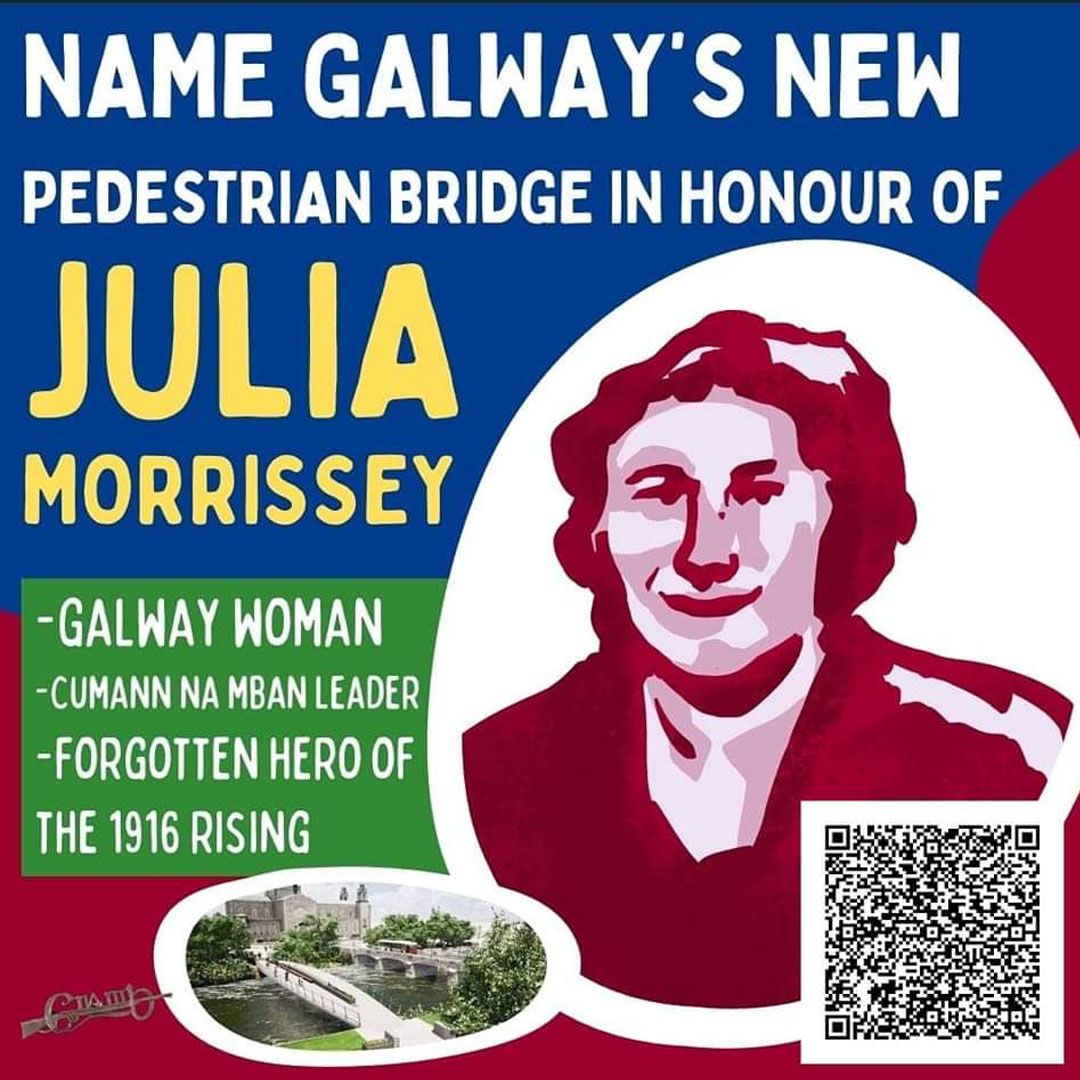
Name Galway's New Pedestrian Bridge in Honour of 1916 Hero Julia Morrissey
An Athenry native, Julia Morrissey, was a key figure in Cumann na mBan's Galway branch. In 1916, she commanded a group of 50 women during Easter week, as part of the rebellion in Galway that was led by Liam Mellows. When Mellows first came to Athenry in 1915, Mor... [more]
Human activity discovered in Ireland 33000 years ago
A REINDEER BONE fragment uncovered in a cave contains a revelation set to dramatically alter the understanding of Irish human history. The bone fragment was found at Castlepook Cave near Doneraile in north Cork where a mammoth bone was discovered in 1972. T... [more]
Wolfe Tones announce anniversary gig
After breaking records at Electric Picnic over the weekend, the Wolfe Tones are set to mark six decades of making music with an anniversary gig in Dublin next year. The Wolfe Tones drew the largest crowd to date to the festival’s Electric Arena on Sunday as a s... [more]
RIA culture night 2023
Come and join us on Culture Night 2023, we will have lots of cultural activities for all ages! Explore the Royal Irish Academy - a hidden Georgian gem tucked away on Dawson Street. View the earliest example of Irish writing - the 6th century Cathach, have a go at som... [more]
More than one million people are actively learning Irish
More than one million people are actively learning Irish on Duolingo according to data from the language app. A recent report (June 2021) listed Irish as the 16th most popular language to learn on the app, with 1.10 million users actively learning the language. ... [more]
United Ireland poll
Linda Ervine places herself in the “don’t know” group when it comes to a united Ireland, saying: “I’m one of those people that will have to be convinced.” Almost one in five voters in Northern Ireland are in the same category, acco... [more]