

Physical Force in Irish Politics
Ireland occupies a position among the nations of the earth unique in a great variety of its aspects, but in no one particular is this singularity more marked than in the possession of what is known as a ‘physical force party’ – a party, that is to say, whose members are united upon no one point, and agree upon no single principle, except upon the use of physical force as the sole means of settling the dispute between the people of this country and the governing power of Great Britain.
Other countries and other peoples have, from time to time, appealed to what the first French Revolutionists picturesquely described as the “sacred right of insurrection,” but in so appealing they acted under the inspiration of, and combated for, some great governing principle of political or social life upon which they, to a man, were in absolute agreement.
The latter-day high falutin ‘hillside’ man, on the other hand, exalts into a principle that which the revolutionsists of other countries have looked upon as a weapon, and in his gatherings prohibits all discussion of those principles which formed the main strength of his prototypes elsewhere and made the successful use of that weapon possible.
Our people have glided at different periods of the past century from moral force agitation, so-called, into physical force rebellion, from constitutionalism into insurrectionism, meeting in each the same failure and the same disaster and yet seem as far as ever from learning the great truth that neither method is ever likely to be successful until they first insist that a perfect agreement upon the end to be attained should be arrived at as a starting-point of all our efforts.
To the reader unfamiliar with Irish political history such a remark seems to savour almost of foolishness, its truth is so apparent; but to the reader acquainted with the inner workings of the political movements of this country the remark is pregnant with the deepest meaning. Every revolutionary effort in Ireland has drawn the bulk of its adherents from the ranks of the disappointed followers of defeated constitutional movements.
After having exhausted their constitutional efforts in striving to secure such a modicum of political power as would justify them to their own consciences in taking a place as loyal subjects of the British Empire, they, in despair, turned to thoughts of physical force as a means of attaining their ends.
Their conception of what constitutes freedom was in no sense changed or revolutionised; they still believed in the political form of freedom which had been their ideal in their constitutional days; but no longer hoping for it from the acts of the British Parliament, they swung over into the ranks of the ‘physical force’ men as the only means of attaining it.
The so-called physical force movement of today in like manner bases its hopes upon the disgust of the people over the failure of the Home Rule movement; it seeks to enlist the people under its banners, not so much by pointing out the base ideals of the constitutionalists or the total inadequacy of their pet measures to remedy the evils under which the people suffer, as by emphasising the greater efficacy of physical force as a national weapon. Thus, the one test of an advanced Nationalist is, in their opinion, one who believes in physical force.
It may be the persons so professing to believe are Republicans; it may be they are believers in monarchy; it may be that Home Rule would satisfy them; it may be that they despise Home Rule. No matter what their political faith may be, if only they are prepared to express belief in the saving grace of physical force, they are acclaimed as advanced Nationalists – worthy descendants of ‘the men of ’98.’
The ’98 Executive, organised in the commencement by professed believers in the physical force doctrine, started by proclaiming its adherence to the principle of national independence “as understood by Wolfe Tone and the United Irishmen,” and in less than twelve months from doing so, deliberately rejected a similar resolution and elected on its governing body men notorious for their Royalist proclivities.
As the ’98 Executive represents the advanced Nationalists of Ireland, this repudiation of the Republican faith of the United Irishmen is an interesting corroboration of the truth of our statement that the advanced Nationalists of our day are utterly regardless of principle and only attach importance to methods – an instance of putting the cart before the horse, absolutely unique in its imbecility and unparalleled in the history of the world.
It may be interesting, then, to place before our readers the Socialist Republican conception of the functions and uses of physical force in a popular movement. We neither exalt it into a principle nor repudiate it as something not to be thought of. Our position towards it is that the use or non-use of force for the realisation of the ideas of progress always has been and always will be determined by the attitude, not of the party of progress, but of the governing class opposed to that party.
If the time should arrive when the party of progress finds its way to freedom barred by the stubborn greed of a possessing class entrenched behind the barriers of law and order; if the party of progress has indoctrinated the people at large with the new revolutionary conception of society and is therefore representative of the will of a majority of the nation, if it has exhausted all the peaceful means at its disposal for the purpose of demonstrating to the people and their enemies that the new revolutionary ideas do possess the suffrage of the majority; then, but not till then, the party which represents the revolutionary idea is justified in taking steps to assume the powers of government, and in using the weapons of force to dislodge the usurping class or government in possession, and treating its members and supporters as usurpers and rebels against the constituted authorities always have been created.
In other words, Socialists believe that the question of force is of very minor importance; the really important question is of the principles upon which is based the movement that may or may not need the use of force to realise its object.
Here, then, is the immense difference between the Socialist Republicans and our friends the physical force men. The latter, by stifling all discussions of principles, earn the passive and fleeting commendation of the unthinking multitude; the former, by insisting upon a thorough understanding of their basic principles, do not so readily attract the multitude, but do attract and hold the more thoughtful amongst them. It is the difference betwixt a mob in revolt and an army in preparation.
The mob who cheer a speaker referring to the hopes of a physical force movement would, in the very hour of apparent success, be utterly disorganised and divided by the passage through the British Legislature of any trumpery Home Rule Bill.
The army of class-conscious workers organising under the banner of the Socialist Republican Party, strong in their knowledge of economic truth and firmly grounded in their revolutionary principles, would remain entirely unaffected by any such manoeuvre and, knowing it would not change their position as a subject class, would still press forward, resolute and undivided, with their faces set towards their only hope of emancipation – the complete control by the working-class democracy of all the powers of National Government.
Thus the policy of the Socialist Republicans is seen to be the only wise one. “Educate that you may be free”; principles first, methods afterwards. If the advocacy of physical force failed to achieve success or even to effect an uprising when the majority were unenfranchised and the secret ballot unknown, how can it be expected to succeed now that the majority are in possession of voting power and the secret ballot safeguards the voter?
The ballot-box was given us by our masters for their purpose; let us use it for our own.
Let us demonstrate at that ballot-box the strength and intelligence of the revolutionary idea; let us make the hustings a rostrum from which to promulgate our principles; let us grasp the public powers in the interest of the disinherited class; let us emulate our fathers and, like the ‘true men of ’98,’ place ourselves in line with the most advanced thought of our age and drawing inspiration and hope from the spectacle presented by the world-wide revolt of the workers, prepare for the coming of the day when the Socialist working-class of Ireland will, through its elected representatives, present its demand for freedom from the yoke of a governing master class or nation – the day on which the question of moral or physical force shall be finally decided.
James Connolly, originally published in the Workers’ Republic
Article originally published on: Saturday 22nd July 1899If you'd like to help with producing further articles, please sign up here!
More articles can be found here.
The project will follow in their footsteps along the path laid down by Hyde, O'Conaire, MacNeill, Cusack and many others through sharing news, ideas, articles of Irish cultural interest and more, as well as helping to support Irish language and cultural initiatives. You can find out more about An Claíomh Solais by clicking on the buttons below, or join our team as we begin the great Gaelic restoration!
Ode to John Devoy, a Forgotten Hero
A forgotten hero it has been said
Was born in Kill at a time many tears in this country were shed
Just before the Great Hunger this child did arrive
And lucky for us Irish he was one who would survive
An immense gra for Irish freedom he held in his heart
And it was when he was young that he first made a start
In his quest to release us Irish from beneath British rule
He was beaten for not singing “God Save the Queen” in his school
Involved in three wars he was one of a few
To take part in all conflicts and see
Read more...
An Interview with Patrick Quinlan from the National Party
Welcome to another in our series of interviews with prominent figures and rising stars in contemporary Irish nationalism!
Today we're talking to Patrick Quinlan from the National Party, a rapidly growing and influential political organisation in Ireland, one of the few if not the only such group with actual elected representatives. Read on to learn about engaging with the system, winning hearts and minds, and the political future for Irish nationalism!
Perhaps you could tell us a little bit about yourself to begin with?
I'm Patrick Quin
Read more...
An interview with Rob Carry
Good afternoon! As part of our ongoing series on rising nationalist stars and voices in Ireland, we're delighted to be able to introduce local community activist, businessman and politician, Rob Carry!
We've been talking about his amazing work for and with his community, as well as his aspirations and plans for the future.
ACS: Can you tell us a little about yourself, your background, and where you're coming from?
RC: Sure. So I’m a small business owner (I run a commercial gym, a martial arts club
Read more...
An Interview with Gavin from Offgrid Ireland
Good morning and welcome to another in our series of interviews with prominent figures and rising stars in modern Irish nationalism!
Today we're talking to Gavin from a prominent and influential online discussion group, the X SPACES Éire Community. This very active group has at one time or another hosted many well-known nationalist names and continues to grow in both size and influence.
ACS: Can you share with our readers some of your background and a little about who you are?
OI: I am an Offaly man, born and bred, now in my la
Read more...
A New Voice For Ireland
We are pleased to introduce a new rising star among Irish nationalists - although she needs no introduction for many of you who have attended Irish Ireland protests recently - Ciara Ní Mhainnín! Her uncompromising voice offers a clear challenge to the establishment and a great example for us all to follow.
Ciara very kindly took the time to join us in an online interview, which we are delighted to publish here.
ACS: What made you decide to get involved with the Irish Ireland cause, was there one particular event or was it more of a process?
Read more...
The last address of Thomas MacDonagh
There is not much left to say. The Proclamation of the Irish Republic has been adduced in evidence against me as one of the Signatories. I adhere to every statement in the Proclamation. You think it already a dead and buried letter, but it lives, it lives. From minds alight with Ireland’s vivid intellect it sprang; in hearts aflame with Ireland’s mighty love it was conceived. Such documents do not die.
The British occupation of Ireland has never for more than one hundred years been compelled to confront in the field of fight a Rising so formidable as that which overwhe
Read more...
Recent News
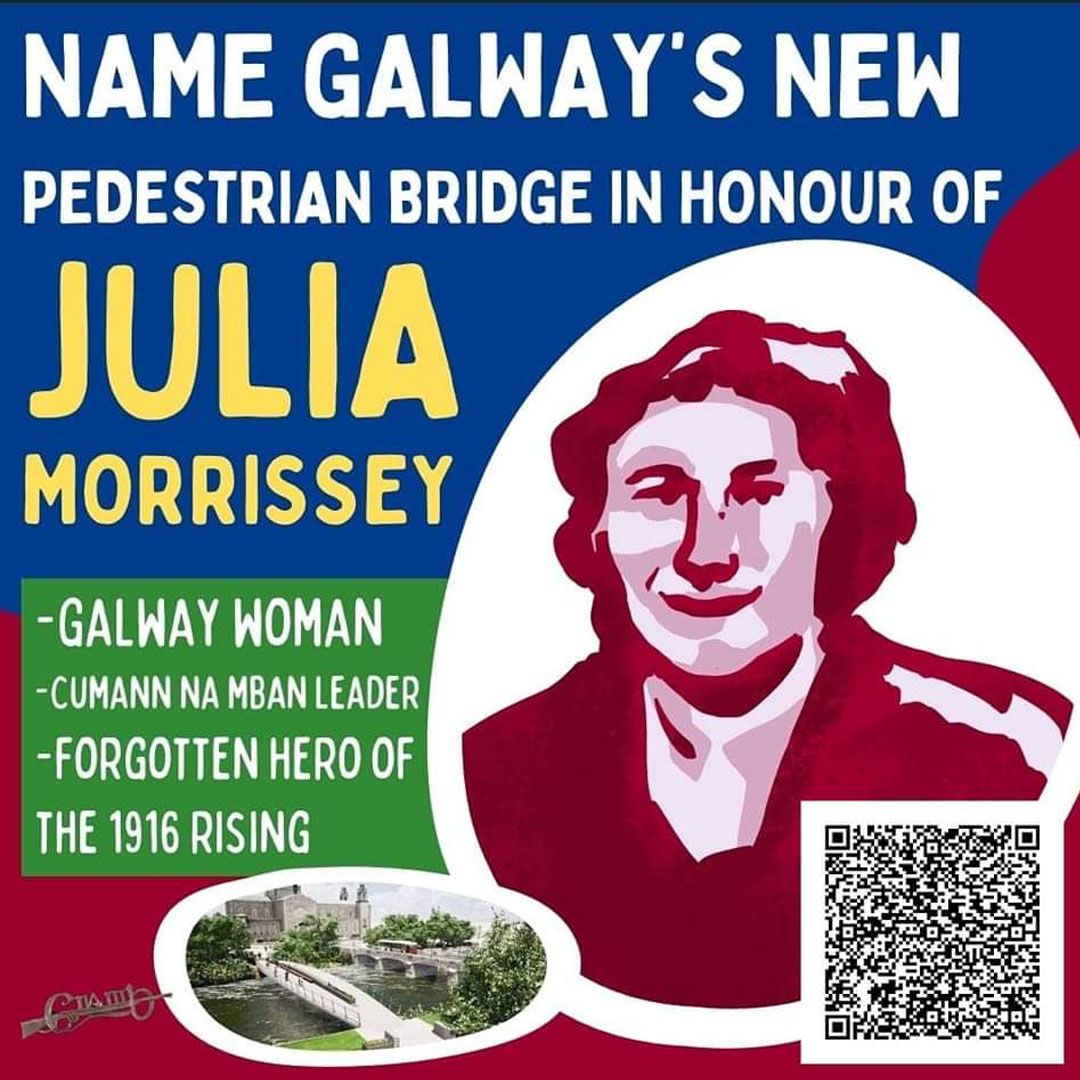
Name Galway's New Pedestrian Bridge in Honour of 1916 Hero Julia Morrissey
An Athenry native, Julia Morrissey, was a key figure in Cumann na mBan's Galway branch. In 1916, she commanded a group of 50 women during Easter week, as part of the rebellion in Galway that was led by Liam Mellows. When Mellows first came to Athenry in 1915, Mor... [more]
Human activity discovered in Ireland 33000 years ago
A REINDEER BONE fragment uncovered in a cave contains a revelation set to dramatically alter the understanding of Irish human history. The bone fragment was found at Castlepook Cave near Doneraile in north Cork where a mammoth bone was discovered in 1972. T... [more]
Wolfe Tones announce anniversary gig
After breaking records at Electric Picnic over the weekend, the Wolfe Tones are set to mark six decades of making music with an anniversary gig in Dublin next year. The Wolfe Tones drew the largest crowd to date to the festival’s Electric Arena on Sunday as a s... [more]
RIA culture night 2023
Come and join us on Culture Night 2023, we will have lots of cultural activities for all ages! Explore the Royal Irish Academy - a hidden Georgian gem tucked away on Dawson Street. View the earliest example of Irish writing - the 6th century Cathach, have a go at som... [more]
More than one million people are actively learning Irish
More than one million people are actively learning Irish on Duolingo according to data from the language app. A recent report (June 2021) listed Irish as the 16th most popular language to learn on the app, with 1.10 million users actively learning the language. ... [more]
United Ireland poll
Linda Ervine places herself in the “don’t know” group when it comes to a united Ireland, saying: “I’m one of those people that will have to be convinced.” Almost one in five voters in Northern Ireland are in the same category, acco... [more]