

The Crime of Poverty
The English robbed the Irish, and having pauperized them, made poverty a crime. Then, the Irish were a proud people, and made desperate efforts to hide their poverty, and no greater offense could be given to one of the old stock than to have poverty thrown in his face – ‘twas the worst aspuchaun that could be thrown at him. We belong to the “ould stock;” there is not a drop of any blood in us, at father or mother’s side for generations, but Irish blood; and we inherit the pride and poverty of the race.
But to have that poverty thrown in our face, after battling with the world for fifty years – and battling during the greater part of those fifty years against the powers that plundered our people – is a thing we will not quietly stand. And then the men that throw aspuchaun, at us – are men who are notoriously as poor as ourselves, men who have sworn to be loyal to England; who have sworn to uphold English rule in Ireland, and who have sworn to make known to England all combinations and conspiracies against the maintenance of English rule in Ireland!
No reader of this UNITED IRISHMAN can say that we have ever spoken an ill word in this paper against Mr. Healy, member of the English Parliament, or against Mr. Dillon, member of the English Parliament, and yet those two gentlemen have the ill manners to go into the Parliament House of England and there strike us in the most sensitive part of a proud Irishman’s person – strike him in his pocket – and proclaim, publish it to the world that we have no pocket at all – that we never had a pocket! ‘Tis true, and pity ‘tis ‘tis true, but we might have had a pocket, if we were as sensible as Mr. Dillon or Mr. Healy, and we will venture to say that more money that was never earned by the spender of it went into Mr. Dillon’s and Mr. Healy’s pocket during the past three years than went into our pockets during the past thirty years that we are struggling in Irish life.
O’Connell said that a man who put himself heart and soul in the Irish cause was sure to die a pauper, and it would be well if these two young parliamentary gentlemen had learned something of O’Connell and his life before they had entered on the burlesque game of trying to get liberty for Ireland by talking in England. We met Mr. Dillon in Philadelphia a few years ago; we were speaking with him, and we left him thinking he was very innocent – very “green.” In reply to a question of ours as to what in the world did he expect from “agitation” in that London Parliament, he told us that he thought they could shame England before the world into doing justice to Ireland. Mr. Parnell was present.
We could only smile, and say we hoped Mr. Dillon would live long; and if he did, we were sure he would grow out of such a notion. And we were hoping lately that Mr. Dillon’s recent experience had educated him out of those silly ideas of his. But it seems we are mistaken; his abuse of us is not personal; we don’t take it as personal – we don’t feel it as much. It is simply a kind of vexation on his part that there are a few men here in America who are standing very much in the way of agitators and humbugs, and that we are among the few.
We said last week, in connection with the “dreams” and delusions of Davitt and others, that we excepted Mr. Dillon and Mr. Parnell from any unpleasant remarks we were called upon to make. Mr. Parnell now stands alone. Were he allowed to follow his parliamentary course, unhandicapped by the Davitts and others who once swore it was by the sword alone Ireland could be emancipated, we could enjoy the joke of his giving all the annoyance and trouble to England that it was possible to give; but when he recruited himself from the Davitt breed, and made demoralization in the ranks of the revolutionary element of Ireland and England, then we could see nothing in the parliamentary patriotism but disaster.
The following two paragraphs are what have provoked us to make our remarks; this is a telegram:
LONDON, June 5. – New interest was developed to-night in Committee on the Crime Prevention bill, owing to the contention of the Irish members that the jurisdictions of the new court should not extend to trials for treason or treason felony when the acts were done or the words spoken outside of Ireland. This limitation was strongly resisted by the government through Sir William Harcourt, who declared that it was necessary to extend the jurisdiction of the court over all cases where a judge and jury would have jurisdictions.
In order to strengthen this view of the case he cited O’Donovan Rossa and stated that if there were only one reader of Rossa’s paper the Crime Prevention act would necessarily deal with him. This statement provoked an irreverent demonstration from the Irish benches. Mr. Healy, in reply, taunted Sir William Harcourt with advertising Rossa for his own purposes. He said that Rossa’s paper would have been dead three months ago if Sir William Harcourt would refrain from making attacks. He concluded by saying that Rossa was as necessary to Sir William Harcourt as Sir William was to Rossa.
And this is part of a speech delivered by Mr. Dillon in the House of Commons, as we find in the Freeman’s Journal of May 20:
THE COERCION BILL.
In the House of Commons, on Wednesday, the adjourned debate on the motion for going into committee on the Prevention of Crime (Ireland) bill was resumed by Mr. Dillon, who, referring to an amendment he had put on the paper, but which he was precluded from moving, namely: “That in the opinion of the House the provisions of the bill were mainly aimed, not at crime, but at political agitation, and if passed into law would render impossible any public combination for protecting the rights of labour in Ireland, and were consequently calculated to drive the oppressed poor in Ireland into secret combination and crime.”
Criticising the provisions of the bill, and referring to the press clause, he stated that the only colour given to the complaints against the Irish press was that one or two of them had quoted extracts from THE UNITED IRISHMAN, edited by O’Donovan Rossa, a man who increased his income by furious attacks on the English Government, who was always on the verge of bankruptcy, and whose newspaper was only kept alive by the denunciation it was continually receiving in this house. (Hear, hear.)
Of course there was “Hear, hear,” from the Englishmen, for Englishmen know very well that it is the action advocated by us that will root the Irish people in the Irish soil and root the English out of Ireland.
Jeremiah O’Donovan Rossa
From The United Irishman
If you'd like to help with producing further articles, please sign up here!
More articles can be found here.
The project will follow in their footsteps along the path laid down by Hyde, O'Conaire, MacNeill, Cusack and many others through sharing news, ideas, articles of Irish cultural interest and more, as well as helping to support Irish language and cultural initiatives. You can find out more about An Claíomh Solais by clicking on the buttons below, or join our team as we begin the great Gaelic restoration!
You don't get to betray us and smile
You don’t get to lecture us on our blood and our past,
Famine headstones paving a road any can pass.
Our villages hollow, our young forced to flee,
While newcomers are housed and our people come last —
that’s your “compassionate” decree.
We remember the coffin ships, the millions who died,
Under cold British rules and indifferent pride.
That horror was on us by foreign command —
Not a blank cheque for every stranger to claim our land.
We emigrated through hardship, built lives far a
Read more...
Ode to John Devoy, a Forgotten Hero
A forgotten hero it has been said
Was born in Kill at a time many tears in this country were shed
Just before the Great Hunger this child did arrive
And lucky for us Irish he was one who would survive
An immense gra for Irish freedom he held in his heart
And it was when he was young that he first made a start
In his quest to release us Irish from beneath British rule
He was beaten for not singing “God Save the Queen” in his school
Involved in three wars he was one of a few
To take part in all conflicts and see
Read more...
An Interview with Patrick Quinlan from the National Party
Welcome to another in our series of interviews with prominent figures and rising stars in contemporary Irish nationalism!
Today we're talking to Patrick Quinlan from the National Party, a rapidly growing and influential political organisation in Ireland, one of the few if not the only such group with actual elected representatives. Read on to learn about engaging with the system, winning hearts and minds, and the political future for Irish nationalism!
Perhaps you could tell us a little bit about yourself to begin with?
I'm Patrick Quin
Read more...
An interview with Rob Carry
Good afternoon! As part of our ongoing series on rising nationalist stars and voices in Ireland, we're delighted to be able to introduce local community activist, businessman and politician, Rob Carry!
We've been talking about his amazing work for and with his community, as well as his aspirations and plans for the future.
ACS: Can you tell us a little about yourself, your background, and where you're coming from?
RC: Sure. So I’m a small business owner (I run a commercial gym, a martial arts club
Read more...
An Interview with Gavin from Offgrid Ireland
Good morning and welcome to another in our series of interviews with prominent figures and rising stars in modern Irish nationalism!
Today we're talking to Gavin from a prominent and influential online discussion group, the X SPACES Éire Community. This very active group has at one time or another hosted many well-known nationalist names and continues to grow in both size and influence.
ACS: Can you share with our readers some of your background and a little about who you are?
OI: I am an Offaly man, born and bred, now in my la
Read more...
A New Voice For Ireland
We are pleased to introduce a new rising star among Irish nationalists - although she needs no introduction for many of you who have attended Irish Ireland protests recently - Ciara Ní Mhainnín! Her uncompromising voice offers a clear challenge to the establishment and a great example for us all to follow.
Ciara very kindly took the time to join us in an online interview, which we are delighted to publish here.
ACS: What made you decide to get involved with the Irish Ireland cause, was there one particular event or was it more of a process?
Read more...
Recent News
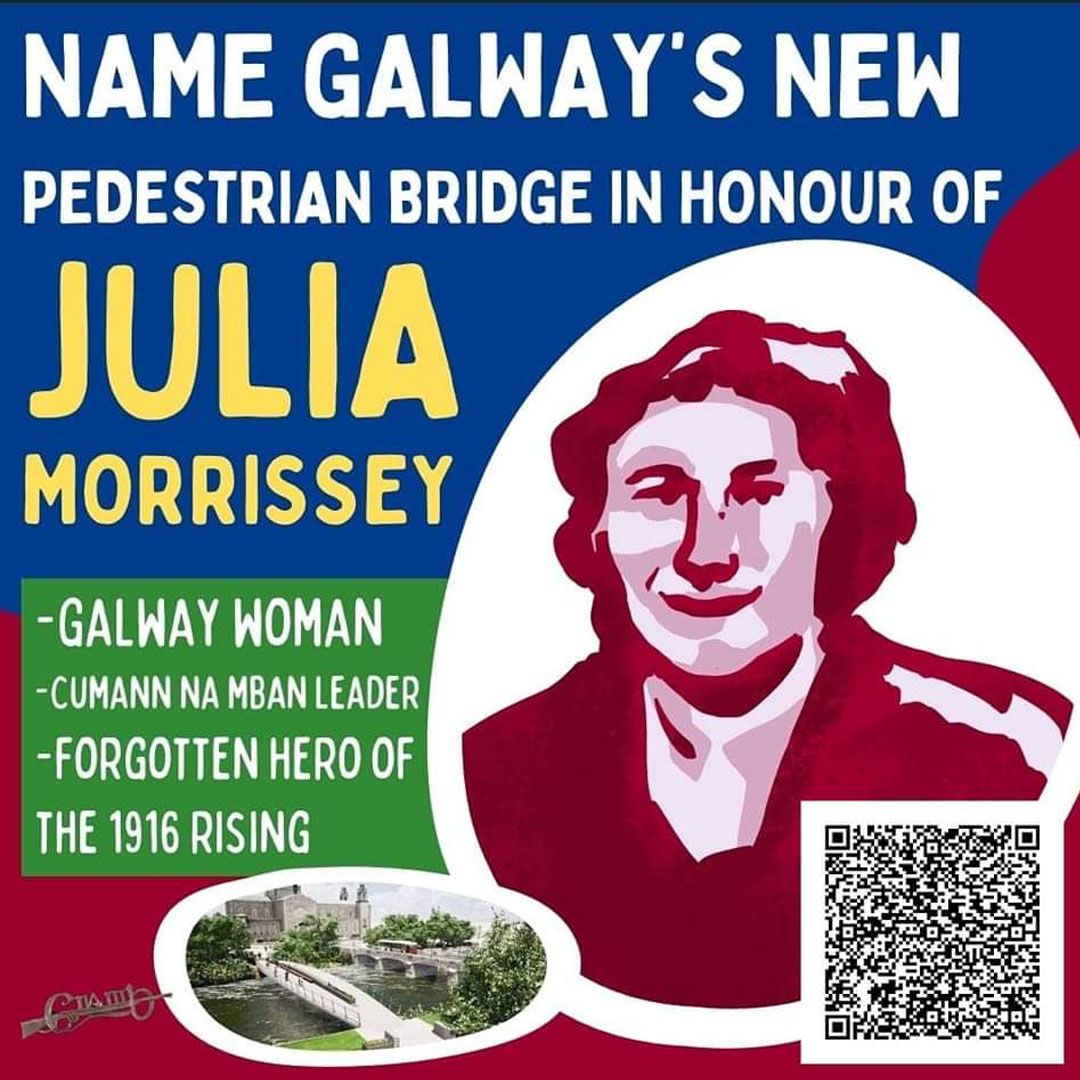
Name Galway's New Pedestrian Bridge in Honour of 1916 Hero Julia Morrissey
An Athenry native, Julia Morrissey, was a key figure in Cumann na mBan's Galway branch. In 1916, she commanded a group of 50 women during Easter week, as part of the rebellion in Galway that was led by Liam Mellows. When Mellows first came to Athenry in 1915, Mor... [more]
Human activity discovered in Ireland 33000 years ago
A REINDEER BONE fragment uncovered in a cave contains a revelation set to dramatically alter the understanding of Irish human history. The bone fragment was found at Castlepook Cave near Doneraile in north Cork where a mammoth bone was discovered in 1972. T... [more]
Wolfe Tones announce anniversary gig
After breaking records at Electric Picnic over the weekend, the Wolfe Tones are set to mark six decades of making music with an anniversary gig in Dublin next year. The Wolfe Tones drew the largest crowd to date to the festival’s Electric Arena on Sunday as a s... [more]
RIA culture night 2023
Come and join us on Culture Night 2023, we will have lots of cultural activities for all ages! Explore the Royal Irish Academy - a hidden Georgian gem tucked away on Dawson Street. View the earliest example of Irish writing - the 6th century Cathach, have a go at som... [more]
More than one million people are actively learning Irish
More than one million people are actively learning Irish on Duolingo according to data from the language app. A recent report (June 2021) listed Irish as the 16th most popular language to learn on the app, with 1.10 million users actively learning the language. ... [more]
United Ireland poll
Linda Ervine places herself in the “don’t know” group when it comes to a united Ireland, saying: “I’m one of those people that will have to be convinced.” Almost one in five voters in Northern Ireland are in the same category, acco... [more]