
The Economic Oppression of Ireland
The history of Irish trade, commerce and industry has yet to be written. Ancient Ireland traded extensively with the Roman Empire, Gaul, Spain and Greece. In the Middle Ages Ireland carried on extensive commerce with France, Flanders, Italy, Spain, Portugal, Germany, and independent Scotland, Wales and England. The Guild merchants of the great Continental trade centres mostly included Irishmen—Bordeaux, Rouen, Bruges, and other cities contain memorials of the Irish merchants.
A Flemish sixteenth-century writer records that in his time the Irish merchants held two fairs yearly in Bruges, where they sold friezes, serges, furs, skins, etc. An Italian poet of the Middle Ages sings the praise of Ireland for the ‘noble woollen stuffs’ she sent to Italy, and Irish robes were used by the Queen of Hungary. The mercantile marine of Ireland was numerous and powerful.
After the definitive establishment of English power in Ireland by Queen Elizabeth it was decried treason to export Irish goods in Irish vessels; Irish shipping was destroyed or seized by England, and it was forbidden to an Irishman to own a ship. Subsequently Ireland was forbidden to export to America aught except victuals, horses, salt, and people. She was forbidden to export cattle, etc., to England. Ireland thereupon turned her attention to a Continental trade, and succeeded in wresting much of the market from England.
Alarmed by this, England removed most of her embargoes; but after the Williamite Wars, Ireland being down, a Penal Code against Irish industry and commerce unparalleled in commercial history was enacted. Irish direct trade with the world was interdicted. The great Irish woollen trade was deliberately suppressed. The Irish cotton manufactures were made subject to a duty of 25 per cent in England, and it was decreed a punishable offence to wear Irish cotton in England or Scotland.
The Irish linen manufacturer was practically excluded from England by an import duty of 30 per cent, and, while bounties were paid to English manufacturers for the export of linen, Ireland was forbidden to participate in such bounties. The Irish fisheries were deliberately impoverished, and a score of minor Irish industries, such as glassmaking, were legislated out of existence.
In Ireland itself the farmers were forbidden to grow corn lest they might undersell the English farmer. In 1716 the unemancipated Irish Parliament sought to pass an Act entitling the farmer to cultivate five acres in every hundred, but the British Government vetoed the Act. Simultaneously civil rights, religious liberty, free tenures, and the right of education were interdicted to four-fifths of the Irish people.
The menace of the arms of the Irish Volunteers gained for Ireland restoration of the right to trade freely with the world, and power to protect and encourage Irish industry. In the twenty years 1780-1800 Ireland, on the admission of Lord Clare, Pitt’s Chancellor, had advanced in cultivation, commerce and manufacture with more rapidity than any other European nation. The Irish woollen, cotton, linen and other trades had been restored or raised to a pitch of production and prosperity never equalled.
Ireland had become a corn-exporting instead of a corn-importing country; the glass, metal and other manufactures were restored, and the Irish fisheries had become one of the first in Europe. In 1800 England forced the Union upon a flourishing Ireland through, as Lord Chief Justice Bushe said, a jealous intolerance of her prosperity.
Under the operation of that infamous Act, Ireland was once more turned back from tillage to grazing land, and one by one all her great industries, except linen, were again destroyed or reduced to skeletons of their former greatness. The Irish Exchequer and the Irish Custom House were suppressed by England. Some industries, such as the tobacco culture, were expressly forbidden by legislation. Others were ruined by less open methods.
Thus the Irish Government before the Union had paid bounties of a few hundred pounds yearly to encourage the exportation of Irish fish. England after the Union paid bounties of £2,000 a year for many years to encourage the importation of British fish into Ireland. In the fifteen years 1829-1844 grants of £200,000 were paid to Scotland for the development of her fisheries. In the same period the amount granted to Ireland was £13,000. The Scots fishermen were allowed a Government brand, but the English Parliament, by an overwhelming majority, refused the same right to the Irish fishermen.
A great Irish industry was ruined, and to-day the annual value of the Irish fisheries is but one-tenth the value of the Scots fisheries.
Thus were treated through the nineteenth century Irish industry and commerce until Ireland once more, as in the seventeenth, was confined to the English market and made subject to England’s economic absolutism. Having thrice within three hundred years destroyed Irish commercial and industrial prosperity by force and fraud—having, in defiance of engagements, made Ireland jointly responsible for England’s National Debt—having made, in the words of Nassau Senior, Ireland the most heavily taxed and England the most lightly taxed country in Europe—England has represented Ireland to the world as a naturally poor and incapable country, kept from want by English benevolence.
Ireland is not the only country whose commerce and industries were forcibly repressed by a jealous rival; nor is she the only country whose soil was confiscated to foreign adventurers; possibly she may not be the only country where a price was placed by its foreign rulers on the schoolmaster’s head; but the Irish people are the one people on the earth to-day whose education, commerce and industry having been repressed, are held up by the repressors to the scorn of the world as a lazy, idle, poverty-stricken and illiterate people.
POPULATION—PERSONS PER SQUARE MILE.
1801 1911
Ireland 166 135
England 152 618
Prior to the ‘Union’ Ireland was, it will be seen, more densely populated than England. England is now over 4 ½ times more densely populated than Ireland.
TOTAL NUMBER OF PERSONS.
1801 1911
Ireland 5,395,456 4,390,219
England 8,892,536 36,070,492
The estimated population of Hungary was in 1801 7,750,000, as compared with Ireland’s 5,400,000. The present population of Hungary is 21,000,000. Had Ireland progressed equally Ireland’s present population would be 15,000,000.
NATIONAL DEBTS.—(FROM THE BRITISH PARLIAMENTARY PAPER 35 OF 1819.)
Debt Per Head of Population.
Ireland £28,545,134 £5 6s. 0d.
Great Britain £450,504,984 £42 18s. 0d.
On the basis of revenue, taxation per head in England in the financial year ending 31st March, 1917, was more than four times greater than the taxation per head in England in the year of the Union. On the same basis the taxation per head in Ireland in the financial year ending 31st March, 1917, was almost eleven times greater than in the year of the Union. The placing of a three-fold burden on the Irishman had its origin in the suppression of the Irish exchequer in 1816.
THE SMALL NATIONS.
Area (sq. miles.) Population. Revenue (£).
Ireland 32,600 4,337,000 24,000,000
Holland 12,600 6,500,000 18,750,000
Belgium 11,600 7,500,000 32,000,000
Denmark 15,600 2,800,000 7,500,000
Switzerland 16,000 3,900,000 3,100,000
Norway 125,000 2,400,000 10,000,000
Greece 42,000 4,900,000 9,250,000
Bulgaria 43,500 4,750,000 10,300,000
Roumania 53,500 7,500,000 24,000,000
Sweden 173,000 5,700,000 22,000,000
Serbia 34,000 4,550,000 8,600,000
Montenegro 5,000 520,000 400,000
The figures are those for 1917 or the latest available.
Arthur Griffith, from the appendix of The Resurrection of Hungary: A Parallel For Ireland.
Article originally published on: Wednesday 12th June 1918If you'd like to help with producing further articles, please sign up here!
More articles can be found here.
The project will follow in their footsteps along the path laid down by Hyde, O'Conaire, MacNeill, Cusack and many others through sharing news, ideas, articles of Irish cultural interest and more, as well as helping to support Irish language and cultural initiatives. You can find out more about An Claíomh Solais by clicking on the buttons below, or join our team as we begin the great Gaelic restoration!

You don't get to betray us and smile
You don’t get to lecture us on our blood and our past,
Famine headstones paving a road any can pass.
Our villages hollow, our young forced to flee,
While newcomers are housed and our people come last —
that’s your “compassionate” decree.
We remember the coffin ships, the millions who died,
Under cold British rules and indifferent pride.
That horror was on us by foreign command —
Not a blank cheque for every stranger to claim our land.
We emigrated through hardship, built lives far a
Read more...
Ode to John Devoy, a Forgotten Hero
A forgotten hero it has been said
Was born in Kill at a time many tears in this country were shed
Just before the Great Hunger this child did arrive
And lucky for us Irish he was one who would survive
An immense gra for Irish freedom he held in his heart
And it was when he was young that he first made a start
In his quest to release us Irish from beneath British rule
He was beaten for not singing “God Save the Queen” in his school
Involved in three wars he was one of a few
To take part in all conflicts and see
Read more...
An Interview with Patrick Quinlan from the National Party
Welcome to another in our series of interviews with prominent figures and rising stars in contemporary Irish nationalism!
Today we're talking to Patrick Quinlan from the National Party, a rapidly growing and influential political organisation in Ireland, one of the few if not the only such group with actual elected representatives. Read on to learn about engaging with the system, winning hearts and minds, and the political future for Irish nationalism!
Perhaps you could tell us a little bit about yourself to begin with?
I'm Patrick Quin
Read more...
An interview with Rob Carry
Good afternoon! As part of our ongoing series on rising nationalist stars and voices in Ireland, we're delighted to be able to introduce local community activist, businessman and politician, Rob Carry!
We've been talking about his amazing work for and with his community, as well as his aspirations and plans for the future.
ACS: Can you tell us a little about yourself, your background, and where you're coming from?
RC: Sure. So I’m a small business owner (I run a commercial gym, a martial arts club
Read more...
An Interview with Gavin from Offgrid Ireland
Good morning and welcome to another in our series of interviews with prominent figures and rising stars in modern Irish nationalism!
Today we're talking to Gavin from a prominent and influential online discussion group, the X SPACES Éire Community. This very active group has at one time or another hosted many well-known nationalist names and continues to grow in both size and influence.
ACS: Can you share with our readers some of your background and a little about who you are?
OI: I am an Offaly man, born and bred, now in my la
Read more...
A New Voice For Ireland
We are pleased to introduce a new rising star among Irish nationalists - although she needs no introduction for many of you who have attended Irish Ireland protests recently - Ciara Ní Mhainnín! Her uncompromising voice offers a clear challenge to the establishment and a great example for us all to follow.
Ciara very kindly took the time to join us in an online interview, which we are delighted to publish here.
ACS: What made you decide to get involved with the Irish Ireland cause, was there one particular event or was it more of a process?
Read more...
Recent News
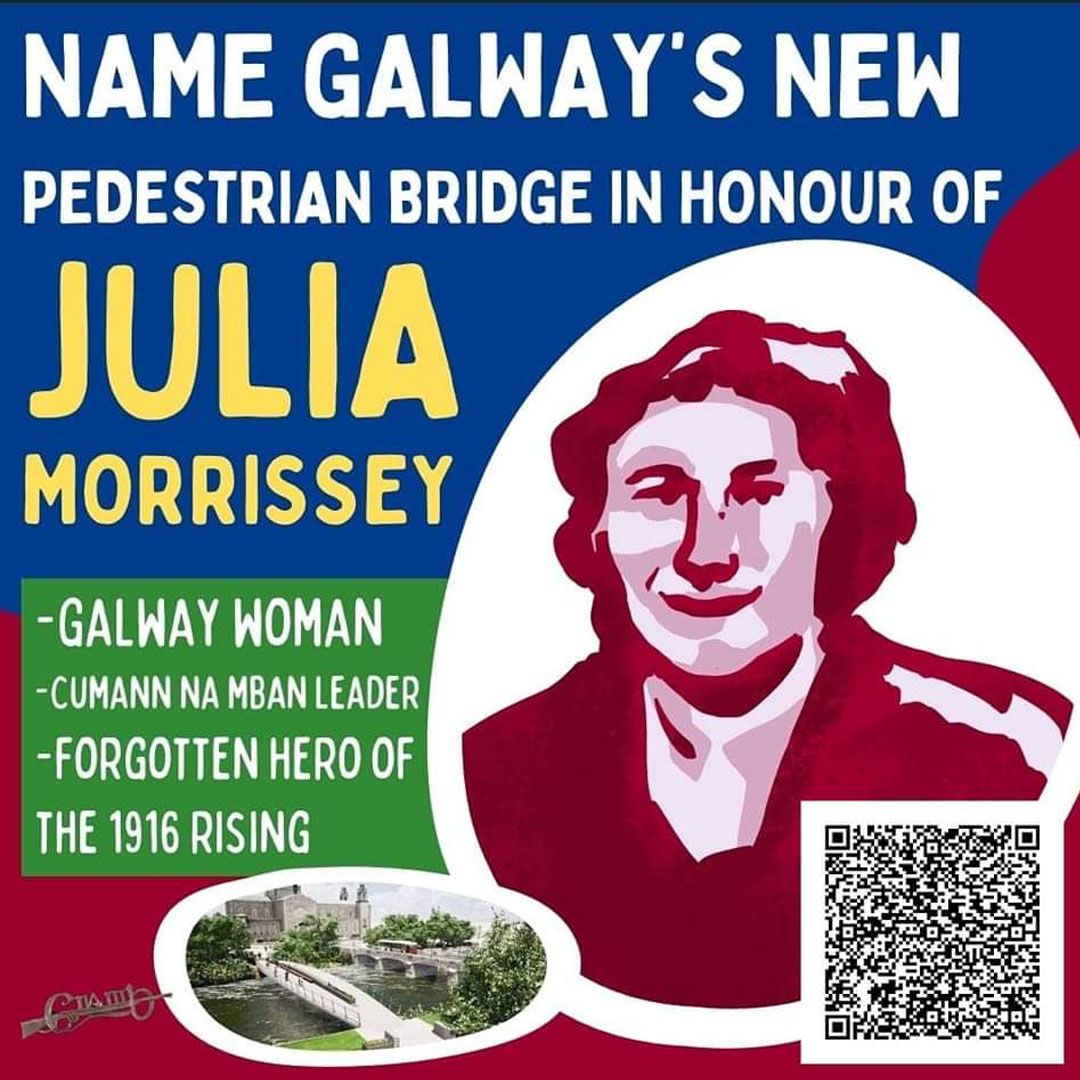
Name Galway's New Pedestrian Bridge in Honour of 1916 Hero Julia Morrissey
An Athenry native, Julia Morrissey, was a key figure in Cumann na mBan's Galway branch. In 1916, she commanded a group of 50 women during Easter week, as part of the rebellion in Galway that was led by Liam Mellows. When Mellows first came to Athenry in 1915, Mor... [more]
Human activity discovered in Ireland 33000 years ago
A REINDEER BONE fragment uncovered in a cave contains a revelation set to dramatically alter the understanding of Irish human history. The bone fragment was found at Castlepook Cave near Doneraile in north Cork where a mammoth bone was discovered in 1972. T... [more]
Wolfe Tones announce anniversary gig
After breaking records at Electric Picnic over the weekend, the Wolfe Tones are set to mark six decades of making music with an anniversary gig in Dublin next year. The Wolfe Tones drew the largest crowd to date to the festival’s Electric Arena on Sunday as a s... [more]
RIA culture night 2023
Come and join us on Culture Night 2023, we will have lots of cultural activities for all ages! Explore the Royal Irish Academy - a hidden Georgian gem tucked away on Dawson Street. View the earliest example of Irish writing - the 6th century Cathach, have a go at som... [more]
More than one million people are actively learning Irish
More than one million people are actively learning Irish on Duolingo according to data from the language app. A recent report (June 2021) listed Irish as the 16th most popular language to learn on the app, with 1.10 million users actively learning the language. ... [more]
United Ireland poll
Linda Ervine places herself in the “don’t know” group when it comes to a united Ireland, saying: “I’m one of those people that will have to be convinced.” Almost one in five voters in Northern Ireland are in the same category, acco... [more]