

The Passing of Anglo-Irish Drama
If it is unlikely to have any other happy outcome – as we fear it is – the tragi-comedy which ran its absurd course at the Abbey Theatre last week will at least concentrate the attention of Gaels on the absolute necessity for the foundation of an Irish Theatre in the capital of Ireland. Anglo-Ireland has shown at its worst, and a very unlovely worst it is.
We cannot congratulate either the Theatre or its critics on the way in which they have acted in face of a crisis. On both sides there have been mock-heroics and hysterics; on both a shameful lack of tolerance and broadmindedness; on both an even more painful want of that saving sense of humour which in his most tense and electric moments never deserts the genuine Gael. If “Art” has contrived to make itself look ridiculous, so have the raucous cryers-down of “Art.”
And both are of Anglo-Ireland; wherein the true Gael who “sees life steadily and sees it whole” may find a certain grim satisfaction.
Mr. Synge’s play was indefensible. But it was defensible – and was ably defended – on almost every ground on which it was attacked. The objections to certain plain-spoken expressions which occurred in the dialogue as it was originally spoken were simply puerile. The serious resentment of the play as a libel on Irish character was almost as inept.
Irish character does not need to be vindicated against Mr. J. M. Synge; and if it did, the audience went a passing strange way about vindicating it. But we do not believe that Mr. Synge intended his play either as a picture or a caricature of Irish life. The charge which we bring against him is graver. Whether deliberately or un-deliberately, he is using the stage for the propagation of a monstrous gospel of animalism, of revolt against sane and sweet ideals, of bitter contempt for all that is fine and worthy, not merely in Christian morality, but in human nature itself.
He lays the scenes of his plays in Ireland merely because Ireland is the country with whose scenery and life he is best acquainted; but it is not Ireland he libels so much as mankind in general, it is not against a nation he blasphemes so much as against the moral order of the universe.
In “The Shadow of the Glen” we find Mr. Synge preaching contempt of what he would doubtless call the “moral convention”; in “The Well of the Saints” he railed obscenely against light, and sweetness, and knowledge, and charity; in “The Playboy of the Western World” – not so much perhaps in the mere story or plot as in the amazingly powerful dialogue – he has produced a brutal glorification of violence, and grossness, and the flesh. In these three plays humanity is in savage revolt.
In the beautiful and wonderfully impressive “Riders to the Sea” humanity is represented as passive and despairing in the hands of some strange and unpitying God. A sinister and unholy gospel, truly.
The Anglo-Irish dramatic movement has now been in existence for ten years. Its net result has been the spoiling of a noble poet in Mr W. B. Yeats, and the generation of a sort of Evil Spirit in the shape of Mr. J. M. Synge. “By their fruits ye shall know them.”
“The Playboy of the Western World” was not a play to be howled down by a little mob. It was a play to be left severely alone by all who did not care to listen to it. The course taken by the objectors was not only undignified, but, as events proved, ineffective. It was, therefore, bad tactics, as well as an infringement of the liberty both of the author and players and of the public.
On the other hand, the action of the Theatre authorities in introducing the police, in personally denouncing members of the audience, and in pressing their vindictiveness so far as to go down to the police courts in order to secure convictions, can only be described as lamentable. The author of “Cathleen Ni Houlahan” at the head of a column of D.M.P men was a sight which will long haunt the memory with that mixture of the odious and the ludicrous which clings to the recollection of the mean deeds of men made for fine things.
Mr. Yeats triumphs for the moment; but he has lost far more than he has gained. As for Anglo-Irish drama – it is the beginning of the end.
PH Pearse
Article originally published on: Saturday 9th February 1907If you'd like to help with producing further articles, please sign up here!
More articles can be found here.
The project will follow in their footsteps along the path laid down by Hyde, O'Conaire, MacNeill, Cusack and many others through sharing news, ideas, articles of Irish cultural interest and more, as well as helping to support Irish language and cultural initiatives. You can find out more about An Claíomh Solais by clicking on the buttons below, or join our team as we begin the great Gaelic restoration!
Ode to John Devoy, a Forgotten Hero
A forgotten hero it has been said
Was born in Kill at a time many tears in this country were shed
Just before the Great Hunger this child did arrive
And lucky for us Irish he was one who would survive
An immense gra for Irish freedom he held in his heart
And it was when he was young that he first made a start
In his quest to release us Irish from beneath British rule
He was beaten for not singing “God Save the Queen” in his school
Involved in three wars he was one of a few
To take part in all conflicts and see
Read more...
An Interview with Patrick Quinlan from the National Party
Welcome to another in our series of interviews with prominent figures and rising stars in contemporary Irish nationalism!
Today we're talking to Patrick Quinlan from the National Party, a rapidly growing and influential political organisation in Ireland, one of the few if not the only such group with actual elected representatives. Read on to learn about engaging with the system, winning hearts and minds, and the political future for Irish nationalism!
Perhaps you could tell us a little bit about yourself to begin with?
I'm Patrick Quin
Read more...
An interview with Rob Carry
Good afternoon! As part of our ongoing series on rising nationalist stars and voices in Ireland, we're delighted to be able to introduce local community activist, businessman and politician, Rob Carry!
We've been talking about his amazing work for and with his community, as well as his aspirations and plans for the future.
ACS: Can you tell us a little about yourself, your background, and where you're coming from?
RC: Sure. So I’m a small business owner (I run a commercial gym, a martial arts club
Read more...
An Interview with Gavin from Offgrid Ireland
Good morning and welcome to another in our series of interviews with prominent figures and rising stars in modern Irish nationalism!
Today we're talking to Gavin from a prominent and influential online discussion group, the X SPACES Éire Community. This very active group has at one time or another hosted many well-known nationalist names and continues to grow in both size and influence.
ACS: Can you share with our readers some of your background and a little about who you are?
OI: I am an Offaly man, born and bred, now in my la
Read more...
A New Voice For Ireland
We are pleased to introduce a new rising star among Irish nationalists - although she needs no introduction for many of you who have attended Irish Ireland protests recently - Ciara Ní Mhainnín! Her uncompromising voice offers a clear challenge to the establishment and a great example for us all to follow.
Ciara very kindly took the time to join us in an online interview, which we are delighted to publish here.
ACS: What made you decide to get involved with the Irish Ireland cause, was there one particular event or was it more of a process?
Read more...
The last address of Thomas MacDonagh
There is not much left to say. The Proclamation of the Irish Republic has been adduced in evidence against me as one of the Signatories. I adhere to every statement in the Proclamation. You think it already a dead and buried letter, but it lives, it lives. From minds alight with Ireland’s vivid intellect it sprang; in hearts aflame with Ireland’s mighty love it was conceived. Such documents do not die.
The British occupation of Ireland has never for more than one hundred years been compelled to confront in the field of fight a Rising so formidable as that which overwhe
Read more...
Recent News
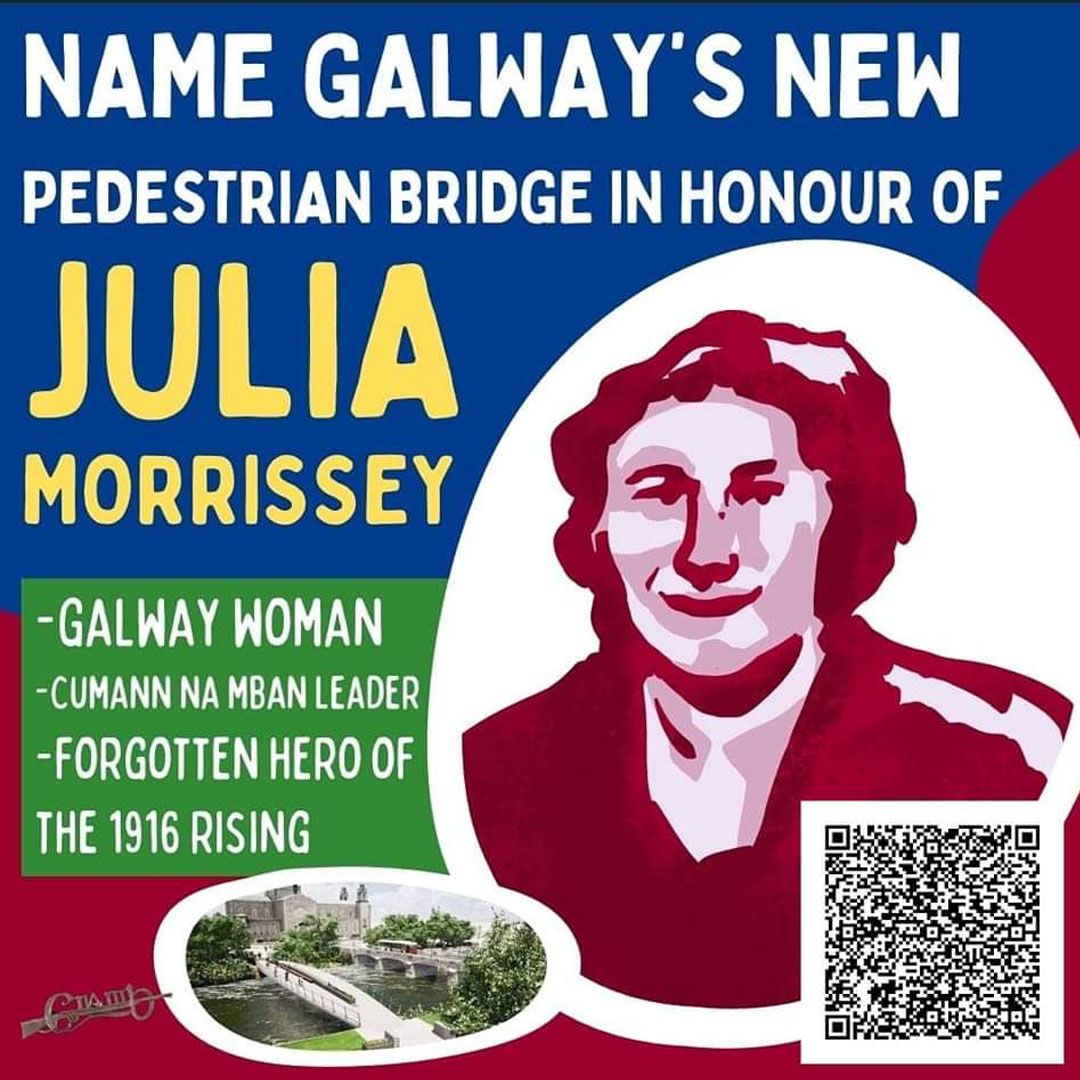
Name Galway's New Pedestrian Bridge in Honour of 1916 Hero Julia Morrissey
An Athenry native, Julia Morrissey, was a key figure in Cumann na mBan's Galway branch. In 1916, she commanded a group of 50 women during Easter week, as part of the rebellion in Galway that was led by Liam Mellows. When Mellows first came to Athenry in 1915, Mor... [more]
Human activity discovered in Ireland 33000 years ago
A REINDEER BONE fragment uncovered in a cave contains a revelation set to dramatically alter the understanding of Irish human history. The bone fragment was found at Castlepook Cave near Doneraile in north Cork where a mammoth bone was discovered in 1972. T... [more]
Wolfe Tones announce anniversary gig
After breaking records at Electric Picnic over the weekend, the Wolfe Tones are set to mark six decades of making music with an anniversary gig in Dublin next year. The Wolfe Tones drew the largest crowd to date to the festival’s Electric Arena on Sunday as a s... [more]
RIA culture night 2023
Come and join us on Culture Night 2023, we will have lots of cultural activities for all ages! Explore the Royal Irish Academy - a hidden Georgian gem tucked away on Dawson Street. View the earliest example of Irish writing - the 6th century Cathach, have a go at som... [more]
More than one million people are actively learning Irish
More than one million people are actively learning Irish on Duolingo according to data from the language app. A recent report (June 2021) listed Irish as the 16th most popular language to learn on the app, with 1.10 million users actively learning the language. ... [more]
United Ireland poll
Linda Ervine places herself in the “don’t know” group when it comes to a united Ireland, saying: “I’m one of those people that will have to be convinced.” Almost one in five voters in Northern Ireland are in the same category, acco... [more]